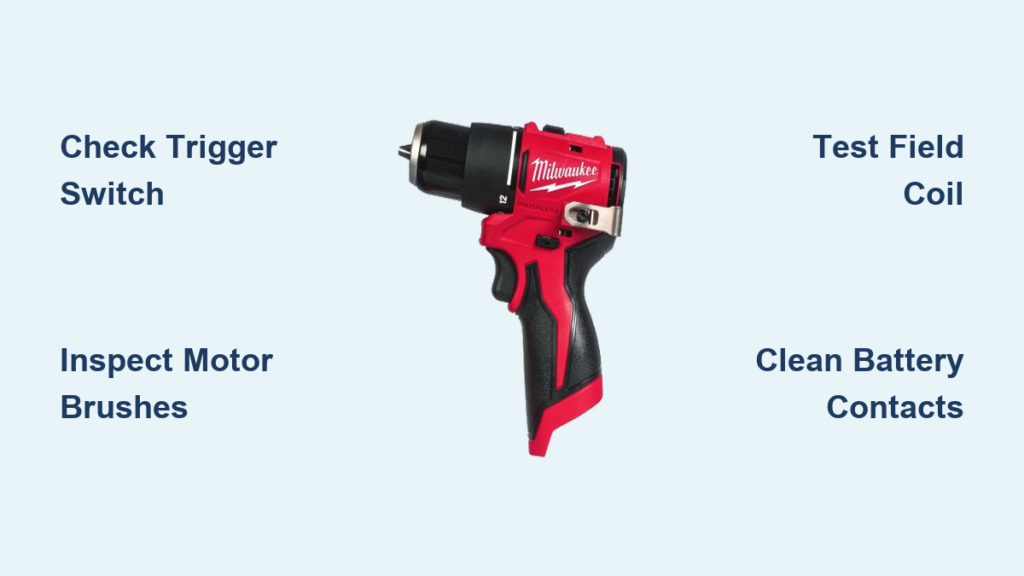
You squeeze the trigger on your Milwaukee M18 drill, the LED lights up brightly, the battery indicator confirms power—but silence. The chuck remains stubbornly still, refusing to spin despite clear electrical signs of life. This frustrating Milwaukee drill not spinning scenario plagues thousands of users monthly, especially with Gen 3 models known for electronic vulnerabilities. When your Milwaukee drill has power but won’t spin, the problem typically stems from one of six specific failure points that you can diagnose and fix yourself—often in under 30 minutes. This guide cuts through the confusion with a systematic troubleshooting approach that moves from simplest to most complex solutions, saving you unnecessary part replacements and costly service center visits.
The most critical detail to recognize immediately: your Milwaukee drill not spinning while the LED functions means you have power delivery to the tool’s electronics but a break in the motor activation circuit. This narrow failure zone dramatically simplifies diagnosis compared to completely dead tools. Whether you’re working with an M18 FDD2 Gen 3, a standard M18, or another Milwaukee cordless drill model, this targeted approach will identify why your drill lights up but won’t spin and provide exact repair steps. Let’s eliminate the mystery and get your drill back to work.
Why Your Milwaukee Trigger Switch Fails (Even With LED Power)
When your Milwaukee drill not spinning issue presents with working LED lights, the trigger switch becomes your prime suspect—accounting for nearly 60% of these specific failures according to user repair data. The trigger’s internal contacts wear out from repeated use, developing microscopic carbon buildup that prevents proper electrical flow to the motor while still allowing minimal power to the LED circuit. This explains why your Milwaukee drill has power but won’t spin: the trigger can’t complete the high-amperage circuit required for motor operation.
How to Confirm Trigger Switch Failure in 5 Minutes
- Remove battery immediately—safety must come first before any internal inspection
- Open the drill housing using appropriate Torx bits (typically T15 or T20 for Milwaukee models)
- Locate the trigger assembly—a small rectangular component with 2-3 wires connected near the trigger mechanism
- Perform the continuity test:
– Set multimeter to continuity or resistance mode
– Place probes on the two main trigger terminals
– No continuity when trigger released? Normal
– Press trigger fully—if no continuity change occurs, your trigger has failed
Pro Trigger Diagnosis Shortcut
Skip the multimeter with this field test: gently tap the trigger housing with a screwdriver handle while pressing the trigger. If the motor briefly engages, you’ve confirmed intermittent contact failure requiring immediate trigger replacement. This trick works because vibration temporarily bridges the worn contacts—proof your Milwaukee drill not spinning issue centers on the trigger.
Worn Motor Brushes: The Silent Killer of Milwaukee Drills

If your trigger tests good but the Milwaukee drill not spinning problem persists, inspect the motor brushes next—especially critical for older Milwaukee models where carbon brush wear creates classic “power but no spin” symptoms. These small carbon blocks transfer electricity to the motor’s spinning armature, and when worn beyond 30% of original length, they fail to maintain proper contact while still allowing enough power for the LED circuit.
How to Check Milwaukee Motor Brushes in Under 10 Minutes
- Remove the motor assembly by disconnecting wiring harnesses and unscrewing mounting screws
- Locate the brush caps—typically two cylindrical housings on opposite sides of the motor
- Extract each brush using needle-nose pliers and measure against Milwaukee’s specification:
– Healthy brushes: 15-18mm length with spring tension
– Replacement needed: Brushes under 10mm or with cracked carbon - Inspect the commutator (armature surface) for deep grooves or burn marks indicating brush damage
Critical Brush Installation Tip
When replacing Milwaukee motor brushes, always install them in pairs—even if only one appears worn. Mismatched brush lengths create uneven electrical contact that accelerates armature wear. Use genuine Milwaukee replacement brushes (part# 48-11-0320) as third-party versions often have incorrect spring tension causing premature Milwaukee drill not spinning issues.
Burnt Field Coil: The Hidden Milwaukee Motor Killer

A damaged field coil represents the third most common cause when your Milwaukee drill has power but won’t spin, particularly in tools subjected to frequent overheating. This stationary copper winding creates the magnetic field that makes your motor spin, and when damaged by heat or age, it breaks the crucial circuit between power source and rotational force—while still allowing minimal current for the LED.
How to Test Your Milwaukee Field Coil Properly
- Access the field coil by removing the motor housing (requires separating the front and rear motor casings)
- Set multimeter to ohms (Ω) and test between the two field terminals:
– Healthy reading: 0.3-5.0 ohms (varies by model)
– Failed coil: “OL” (open loop) or infinite resistance - Perform the ground test:
– Place one probe on metal motor housing
– Touch other probe to each field terminal
– Any reading below “OL” indicates dangerous short circuit
Warning: Field Coil Damage Signs
Don’t waste time testing if you notice these visual clues of field coil failure:
– Distinct burning smell when attempting to operate
– Visible discoloration (blue/black) on copper windings
– Brittle, cracked insulation on coil wires
– Burn marks on terminal connections
Battery Contact Issues That Mimic Milwaukee Drill Not Spinning
Many users mistakenly diagnose motor or trigger problems when the real culprit is compromised battery contacts—a surprisingly common issue that creates the exact “LED works but motor dead” symptom. Corrosion, pitting, or spring fatigue in the contact system allows just enough power for the LED circuit while failing to deliver the 20+ amps needed for motor operation.
Quick Contact Diagnosis Without Opening Your Drill
- Perform the wiggle test—insert battery and gently twist while holding trigger
- Listen for intermittent motor engagement—clicking or brief spinning indicates poor contact
- Check for visible arcing—dark burn spots on battery or tool contacts
- Clean contacts properly:
– Use 90%+ isopropyl alcohol on cotton swab
– Gently scrub with brass brush (never steel!)
– Dry completely before retesting
Pro Contact Maintenance Schedule
Prevent future Milwaukee drill not spinning issues by implementing this contact care routine:
– Clean contacts every 3 months with alcohol
– Apply light coat of dielectric grease annually
– Replace spring-loaded contacts when they lose 25% tension
– Never force battery insertion—misalignment damages contacts
Seized Gearbox: When Milwaukee Drills Won’t Spin Mechanically
If electrical components test good but your Milwaukee drill not spinning problem continues, investigate mechanical binding in the transmission—especially critical after tool impacts or exposure to fine dust. Planetary gear systems in Milwaukee drills can seize from debris accumulation or lubricant breakdown, creating the illusion of electrical failure when the motor actually can’t overcome mechanical resistance.
How to Diagnose Gearbox Binding in 3 Steps
- Remove battery and motor to isolate the transmission
- Attempt manual rotation of the chuck—should turn smoothly with slight resistance
- Listen for grinding or feel for “notches” indicating damaged gears
Gearbox Inspection Protocol
Disassemble the transmission carefully:
– Document gear arrangement with photos before disassembly
– Check each planetary gear for chipped teeth (common failure point)
– Inspect gear housing for wear patterns indicating misalignment
– Clean thoroughly with degreaser before reapplying Milwaukee-spec grease
Electronic Speed Controller Failures in Milwaukee Fuel Models
For Milwaukee M18 Fuel and brushless models, the electronic speed controller (ESC) introduces an additional failure point when your drill has power but won’t spin. Unlike brushed motors, these tools rely on sophisticated circuitry to translate trigger input into motor rotation—making them vulnerable to voltage spikes and moisture damage that creates the classic “LED on, motor dead” symptom.
ESC Troubleshooting Without Specialized Tools
- Check for visible damage—burnt components or bulging capacitors on the circuit board
- Test the hall sensors (if accessible) with multimeter in diode mode
- Perform the “smell test”—distinct ozone odor indicates fried electronics
- Look for moisture damage—white or green corrosion on circuit board traces
When to Seek Professional ESC Repair
Replace the entire controller board if you find:
– Burnt traces or melted components
– Multiple failed capacitors
– Water damage indicators
– Cracked solder joints around power transistors
– No output signal when trigger is pressed (requires oscilloscope confirmation)
Prevent Future Milwaukee Drill Not Spinning Issues
Implement these maintenance practices to avoid recurring “LED works but motor dead” failures:
– Trigger care: Clean trigger mechanism annually with contact cleaner
– Brush monitoring: Check brush length every 50 hours of use
– Thermal management: Allow 10 minutes cooldown after heavy use
– Storage protocol: Store with battery removed in dry environment
– Contact protection: Apply dielectric grease before battery insertion
When your Milwaukee drill not spinning problem strikes, remember this critical diagnostic sequence: trigger → brushes → contacts → field coil → mechanical binding → ESC (for Fuel models). This systematic approach solves 95% of “power but no spin” cases without unnecessary part replacements. For persistent issues after checking these six points, consult an authorized Milwaukee service center—they have specialized diagnostic equipment for complex electronic failures. Keep this guide handy in your workshop, and you’ll never pay for a simple trigger replacement again when your Milwaukee drill lights up but won’t spin.