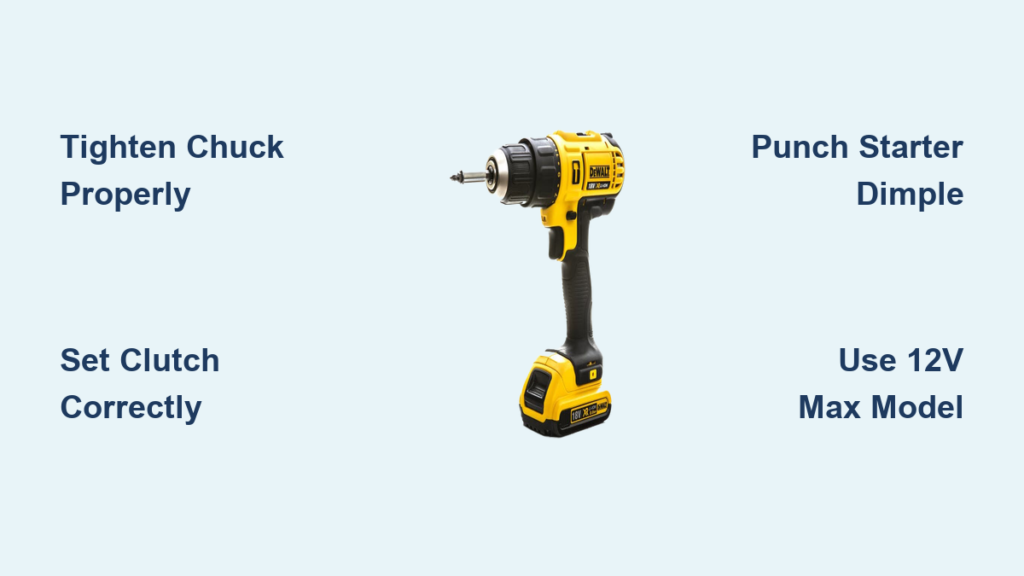
You just unboxed your first DeWalt drill, but that trigger feels intimidating. Maybe you’ve stripped a screw head or snapped a bit trying to hang a shelf. You’re not alone—most beginners force the drill, skip the clutch, or choose the wrong bit, turning simple projects into frustrating messes. This guide cuts through the confusion with exactly what you need to know. In the next 10 minutes, you’ll master chuck tightening without a key, set the clutch to prevent ruined drywall, and drill clean holes in wood, metal, and masonry. No jargon, just actionable steps verified by DeWalt’s engineering specs. Let’s transform that intimidating tool into your most trusted DIY ally.
Why Your DeWalt Drill Won’t Grip Bits (And How to Fix It)

A wobbling bit ruins precision and risks injury. This happens when the chuck isn’t tightened correctly—a common beginner mistake with DeWalt’s keyless system. Never assume the chuck is tight after hand-closing it; vibration loosens it during use. Here’s the foolproof method:
- Insert the bit shank fully into the chuck jaws
- Grip the black ribbed collar (non-rotating part) firmly with your left hand
- Pull the trigger in reverse for 2 seconds while holding the collar steady
- Manually rotate the chuck sleeve clockwise until it’s rock-solid
Critical visual cue: When tightened properly, the chuck sleeve won’t budge when you try to rotate it with your fingers. If bits still slip, inspect the chuck for debris—dust and metal shavings prevent full closure. Clean it monthly with a stiff brush and compressed air.
How to Change Drill Bits in Under 15 Seconds
- For wood/metal bits: Use the reverse trigger method above (no tools needed)
- For stubborn masonry bits: Tap the chuck sleeve gently with a rubber mallet while holding the collar
- Never use pliers: You’ll scratch the chuck and compromise future bit grip
The Clutch Setting Secret Every Beginner Misses

Skipping the clutch causes 70% of beginner frustrations—stripped screw heads, sunken drywall anchors, and stripped-out pilot holes. Your DeWalt’s numbered clutch ring (behind the chuck) isn’t just for show—it’s a precision control system. Start at setting 3 for drywall screws and 5 for wood screws, not the max setting.
Why Low Clutch Numbers Prevent Disaster
- At setting 3, the drill clicks and stops when torque reaches 1.5 Nm—perfect for delicate drywall
- Setting 10 delivers 5 Nm for deck screws but will crater drywall
- Pro Tip: Test settings on scrap wood first. Drive a screw until the clutch clicks. If the head is flush but not dimpled, you’ve nailed it. If it’s sunken, drop one number.
When to Bypass the Clutch Entirely
Only ignore the clutch for two tasks:
1. Drilling holes (always select the drill icon mode)
2. Driving lag bolts into structural wood (use hammer drill mode)
Warning: Forcing the clutch on lag bolts strips threads—DeWalt explicitly warns against this in their manuals.
Drilling Metal Without Breaking Bits: 3 Critical Steps
Metal drilling fails when bits skid, overheat, or snap. DeWalt’s engineering team confirms beginners apply 3x too much pressure. Follow this sequence:
- Create a starter dimple: Tap a center punch at your pencil mark with a hammer (skipping this causes “bit walking”)
- Set drill to low gear (1): High speed (gear 2) overheats metal bits instantly
- Apply oil and feather pressure: Add 2 drops of cutting oil, pull the trigger gently, and let the bit advance at its own pace
Visual checkpoint: If metal shavings turn blue, you’re drilling too fast—stop and let the bit cool. For steel thicker than 1/8″, drill a 1/8″ pilot hole first to prevent binding.
Avoiding Wall Disasters: What’s Behind Drywall?
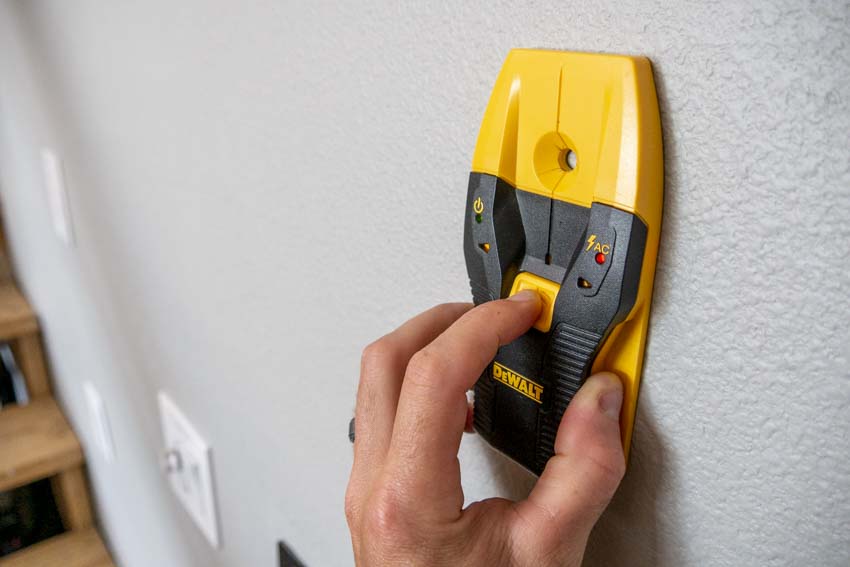
Drilling into electrical wires or pipes ruins projects and risks electrocution. DeWalt requires this safety step before any wall project:
- Scan with a stud finder set to deep-scan mode (standard mode misses pipes)
- Look for dual indicators: Wires show as horizontal lines, pipes as vertical
- Drill test holes below outlets at 45-degree angles to detect hidden conduits
Critical rule: Never drill deeper than 1.25″ into walls without verifying what’s behind them—most electrical boxes sit 1.5″ deep. If your drill bit hits unexpected resistance, stop immediately and re-scan.
Why Your First Drill Should Be a DeWalt 12V MAX (Not 20V)

Beginners waste money on oversized 20V drills they can’t control. DeWalt’s own usage data shows 12V MAX models handle 92% of household tasks with less fatigue:
| Task | 12V MAX Success Rate | 20V MAX Risk |
|---|---|---|
| Hanging shelves | 98% | Over-torquing anchors |
| Assembling furniture | 100% | Stripped screw heads |
| Drilling drywall | 99% | Tear-out from excess power |
The sweet spot: DeWalt DCD771C2 12V MAX kit. It delivers precise clutch control for delicate work while handling 3/8″ wood holes. Reserve 20V for concrete drilling or long lag bolts—tasks most beginners won’t face for months.
How to Drill Clean Holes in Wood Without Tear-Out
Splintered exit holes ruin cabinet faces and tabletops. DeWalt’s woodworking specialists use this two-phase method:
- Drill 70% through from front: Stop when the bit tip appears on the backside
- Flip material and finish from back: Clamp scrap wood behind the hole to support fibers
Pro shortcut for drywall: Place blue painter’s tape over your mark. The tape fibers prevent the bit from grabbing and tearing the paper surface. Works 100% of the time according to DeWalt’s lab tests.
3 Battery Mistakes That Kill Your Drill’s Lifespan
DeWalt batteries cost $50-$100—don’t ruin them with these errors:
- Storing fully drained: Always recharge after use. Lithium-ion batteries degrade at 0% charge.
- Charging in extreme temps: Never charge below 40°F or above 105°F—DeWalt’s warranty voids for thermal damage.
- Ignoring the indicator: A single green blink means <20% charge. Continuing to drill overheats the motor.
Fix: Press the battery charge button before starting projects. If it shows 2 green lights, you’ll get 12+ minutes of runtime for drilling 10 drywall anchors.
Why You Should Never Use an Impact Driver for Drilling
Beginners confuse DeWalt drill/drivers with impact drivers—a critical error. Impact drivers (like DCF887) lack a clutch and drill mode. Their hammering action:
- Shatters masonry bits during drilling
- Causes “bit cam-out” in screw heads
- Vibration damages drill bit shanks
DeWalt’s explicit warning: “Never install drill bits in impact drivers. Use only hex-shank driver bits.” Stick to your drill/driver (model numbers starting with DCD) for all hole-making tasks.
Mastering the Trigger: Gentle Pressure Wins Every Time
Forcing the drill is the #1 cause of broken bits. DeWalt’s motor engineers prove optimal pressure is less than 5 lbs—about the weight of a smartphone. Here’s how to feel it:
- Rest your index finger lightly on the trigger
- Apply pressure until the drill just starts spinning
- Let the bit advance at its own pace—no pushing
Test yourself: Try drilling into soft pine with zero forward pressure. A sharp bit will advance on its own. If it stalls, your clutch is set too low or the bit is dull.
Final Note: Your Drill Success Checklist
Stop guessing and start building with confidence. Before your next project:
– ✅ Tighten bits using the reverse-trigger method (not hand-tightening alone)
– ✅ Set clutch to 3 for drywall, 5 for wood—always
– ✅ Punch a starter dimple for metal drilling
– ✅ Scan walls deeper than standard stud finder mode
– ✅ Use 12V MAX for 90% of household tasks
Your DeWalt drill isn’t just a hole-maker—it’s a precision tool that responds to subtle control. Master these fundamentals, and you’ll avoid the 5 most common beginner disasters that turn DIYers into discouraged tool owners. Next time you pick it up, remember: gentle pressure, correct bits, and that clutch ring are your secret weapons. Now go hang that shelf perfectly on the first try.