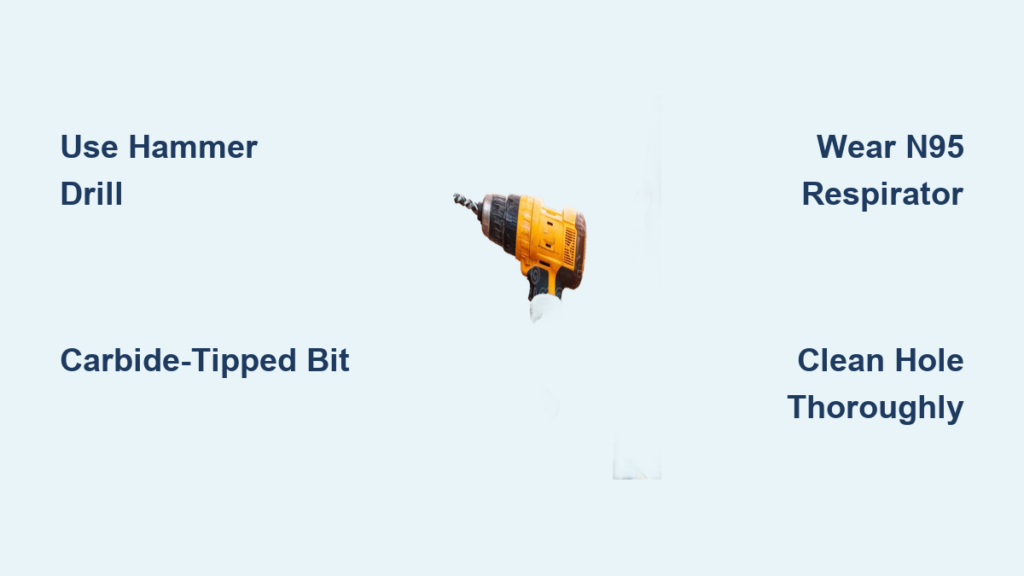
Drilling into brick separates DIY novices from confident home improvers. That frustrating moment when your drill bit skates across the surface—leaving a scratched wall but no hole—stops right here. Brick’s deceptive hardness requires specialized techniques that most tutorials overlook, yet mastering this skill unlocks everything from heavy TV mounts to elegant exterior lighting. Without the right approach, you risk crumbling mortar, shattered bits, or dangerous silica dust exposure. This guide delivers exactly what you need: no fluff, no generic advice, just battle-tested methods verified by masonry professionals. You’ll discover why 90% of failed brick drilling stems from skipping three critical prep steps, how to choose between hammer drills and rotary hammers, and why anchor selection makes or breaks your project’s longevity. By the end, you’ll drill clean, secure holes that hold heavy loads for decades—without cracking a single brick.
Why Standard Drills Fail on Brick Walls (and the 2 Tools That Won’t)
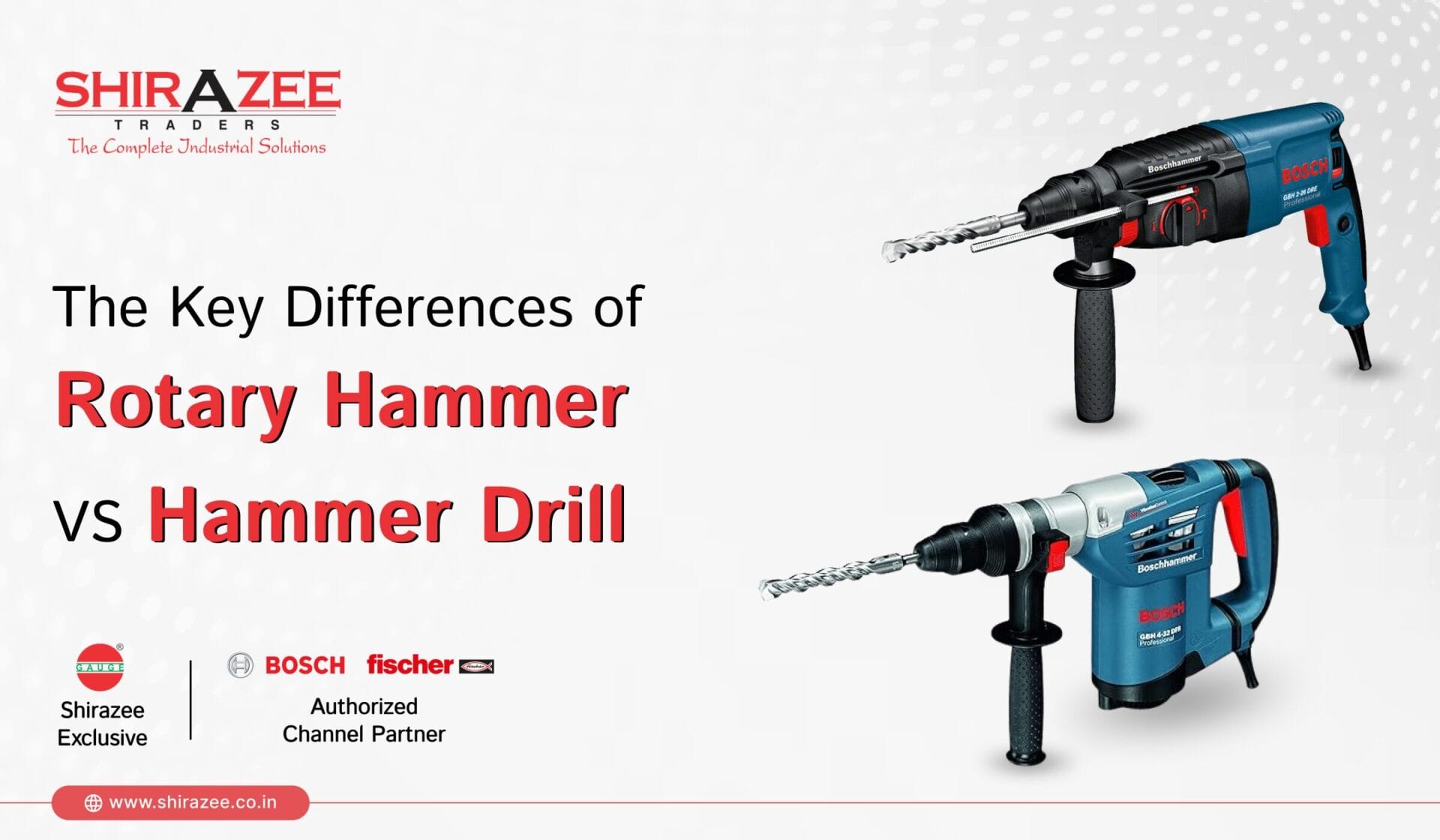
Attempting brick drilling with a regular drill guarantees frustration and damage. Standard twist bits lack the carbide reinforcement needed to grind through silica-rich brick, causing rapid overheating and dulling. Worse, the rotational-only action forces you to apply excessive pressure, which cracks bricks instead of penetrating them. You need tools engineered for pulverization, not just rotation.
Hammer Drill vs. Rotary Hammer: Which Fits Your Project?
Hammer drills are the DIY sweet spot for most brick projects. Their dual-action mechanism combines rotation with rapid forward/backward hammering (up to 48,000 BPM), pulverizing brick particles without cracking the structure. They handle holes up to 1/2-inch diameter in soft to medium-hard bricks—perfect for mounting shelves or light fixtures. Crucially, they accept standard 3/8-inch or 1/2-inch shank masonry bits, keeping costs reasonable.
Rotary hammers become essential for hard bricks, deep holes (over 3 inches), or reinforced walls. Their piston-driven hammering delivers 5-10x more impact energy than hammer drills, drilling 30% faster with less user fatigue. They require SDS-Plus or SDS-Max shank bits that lock securely during high-impact operation. Skip this powerhouse if you’re hanging a single picture frame, but never attempt structural anchors without it.
The Carbide-Tip Non-Negotiable for Brick Drilling
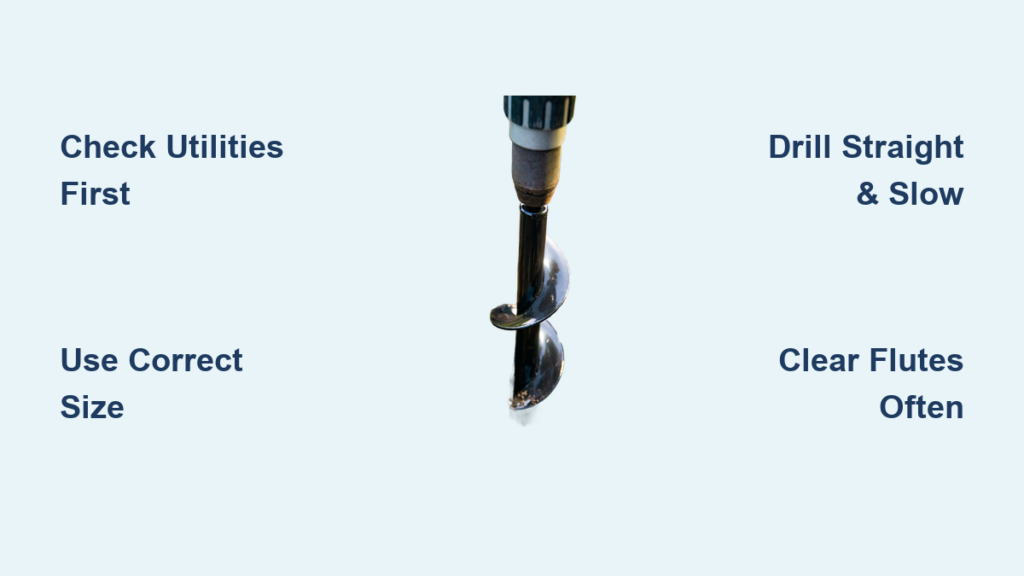
Never substitute standard twist bits—they’ll snap instantly. Carbide-tipped masonry bits feature a hardened tungsten carbide spear point brazed onto a steel body, designed to chip away brick rather than slice it. For 1/4-inch anchors, use a 1/4-inch bit; for 3/8-inch anchors, use 3/8-inch. The knowledge base confirms: “For a 1/4″ fastener, you typically need a 1/4″ bit.” Always verify bit compatibility with your drill type—SDS bits won’t fit standard chucks.
Non-Negotiable Safety Gear: Protecting Your Lungs from Silica Dust

Skipping safety gear when drilling brick isn’t just risky—it’s potentially life-threatening. Brick dust contains crystalline silica, a known carcinogen that causes irreversible lung scarring (silicosis) with repeated exposure. The CDC states there’s no safe exposure level, making proper protection non-optional.
The 3 Must-Wear Items for Brick Drilling
- N95/P100 Respirator: A basic dust mask filters only 60% of silica particles. Invest in a NIOSH-approved N95 (filters 95%) or P100 (99.97%) respirator with an exhalation valve for comfort during extended drilling.
- ANSI-Z87.1 Safety Goggles: Regular sunglasses won’t stop high-velocity brick shards. Sealable goggles prevent dust migration into eyes during bit jams.
- HEPA Vacuum Attachment: This is your secret weapon. Tape a shop-vac hose directly to the drill bit shank using masking tape. As you drill, it captures 99% of dust at the source—critical for indoor projects.
Critical Wire and Pipe Detection Steps
Before touching a drill, perform this 2-minute hazard check:
– Use an AC-detecting stud finder (not basic models) to scan for live electrical wires. Move horizontally and vertically from your mark—wires often run parallel to studs.
– Call 811 (US) 3 days before outdoor projects to have underground utilities marked free of charge. Never assume depth—gas lines can be as shallow as 12 inches.
– Knock-test the wall: Tap around your mark with a screwdriver handle. Hollow sounds indicate voids behind brick; consistent solid thuds confirm safe drilling zones.
How to Mark Brick Perfectly: Avoiding Drill Bit Walk-Off
Even with perfect gear, a skating drill bit ruins your first attempt. Brick’s smooth, non-porous surface gives bits zero traction, causing them to “walk” sideways under pressure. This isn’t user error—it’s physics demanding a precision solution.
The Center Punch Technique That Guarantees Accuracy
- Mark your spot with a fine-tip pencil (not marker—ink smudges on brick).
- Place a masonry nail tip directly on the mark.
- Strike once firmly with a hammer to create a 1/16-inch-deep dimple. The knowledge base emphasizes: “This prevents the drill bit from ‘walking’ or skating across the brick surface.”
- Verify alignment with a level before drilling—especially for multi-hole projects like shelf brackets.
Depth Control: Why Tape Beats Guesswork
Drilling too shallow prevents anchor expansion; drilling too deep weakens structural integrity. Solve this instantly:
– Wrap painter’s tape around your bit at the exact depth needed (e.g., 1.5 inches for a standard sleeve anchor).
– Stop drilling when tape touches the wall—no measuring mid-job. For uneven brick surfaces, use a depth gauge bit stop accessory ($8 at hardware stores).
Step-by-Step: Drilling Clean Holes in Brick with a Hammer Drill
This method works for 95% of home brick projects. Follow these steps precisely to avoid overheating bits or cracking bricks.
Starting the Hole: The 45-Degree Trick
Begin at a 45-degree angle to the wall, applying light pressure. This creates a shallow guide groove in 5-10 seconds. Then gradually tilt to 90 degrees as the bit bites deeper. Rushing this step causes immediate skating—let the carbide tip grind its own path.
The 20-Second Cooling Cycle That Saves Bits
Drill in 15-20 second bursts, then retract completely. Why? Masonry bits lose temper (hardness) above 400°F. The knowledge base warns: “Do not let the bit overheat.” During pauses:
– Clear dust from the hole with a wire brush or compressed air
– Dip the bit in water (for standard drills) or let it air-cool (for hammer drills)
– Resume with firm, steady pressure—never lean your body weight onto the drill
Hole Cleaning: The Forgotten Step That Secures Anchors
A dusty hole = a loose anchor. After drilling:
1. Blow out debris with 3 short bursts from compressed air (never your mouth—silica risk).
2. Vacuum the hole using a narrow attachment.
3. Verify cleanliness by inserting a toothpick—it should slide in smoothly.
The knowledge base stresses: “Clean the hole before inserting a fastener. This ensures a secure hold.”
Anchor Selection Guide: Plastic Plugs vs. Sleeve Anchors for Brick
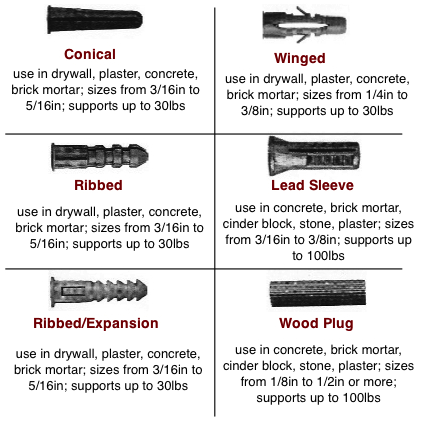
Your hole is useless without the right anchor. Mismatched anchors fail under load—here’s how to choose based on weight and brick type.
When to Use Plastic Wall Plugs (and When to Avoid Them)
Best for: Light loads (under 10 lbs) in solid brick, like picture hooks.
Critical rule: Drill the hole 1/16-inch smaller than the plug’s outer diameter. Example: For a 1/4-inch plug, use a 7/32-inch bit. This allows the plug to expand tightly against brick.
Never use in crumbling mortar joints—brick only.
Heavy-Duty Anchoring: Sleeve Anchors vs. Chemical Epoxy
Sleeve anchors (best for 50-200 lb loads):
– Insert into hole, then drive the bolt. The sleeve expands behind the brick face.
– Requires precise hole depth—match anchor length exactly.
Chemical anchors (for 200+ lb loads like TV mounts):
– Inject epoxy resin into hole, insert threaded rod.
– Bonds directly to brick—holds 2-3x more than mechanical anchors.
– Pro tip: Chill resin in freezer for 10 minutes before use—it flows deeper into brick pores.
Post-Drill Cleanup: Why Vacuuming Dust Is Non-Negotiable
Your project isn’t finished when the anchor is set. Silica dust lingers for weeks, contaminating your home. Skip this step, and you risk long-term respiratory damage.
The 3-Step Dust Elimination Protocol
- Vacuum immediately with a HEPA-filtered shop vac—standard vacuums blow dust back into the air.
- Wipe surfaces with a damp microfiber cloth (dry cloths resuspend dust).
- Seal debris in a plastic bag before disposal—never sweep dry.
Final Anchor Test: The “Fist Bump” Security Check
Before hanging heavy items:
– Tap anchors gently with a hammer to seat them fully.
– Apply gradual pressure by pushing sideways with your fist—not your full weight.
– Listen for cracking sounds—if heard, stop immediately and relocate the hole 2 inches away.
Drilling into brick becomes effortless when you align tools, technique, and safety. Remember: carbide bits + hammer action + clean holes = unshakable anchors. For projects involving structural loads or reinforced brick, consult a professional—but for 95% of home improvements, this guide gives you everything needed. Now grab your hammer drill, tape that HEPA vacuum hose, and transform your brick walls with confidence. Your perfectly drilled holes await.