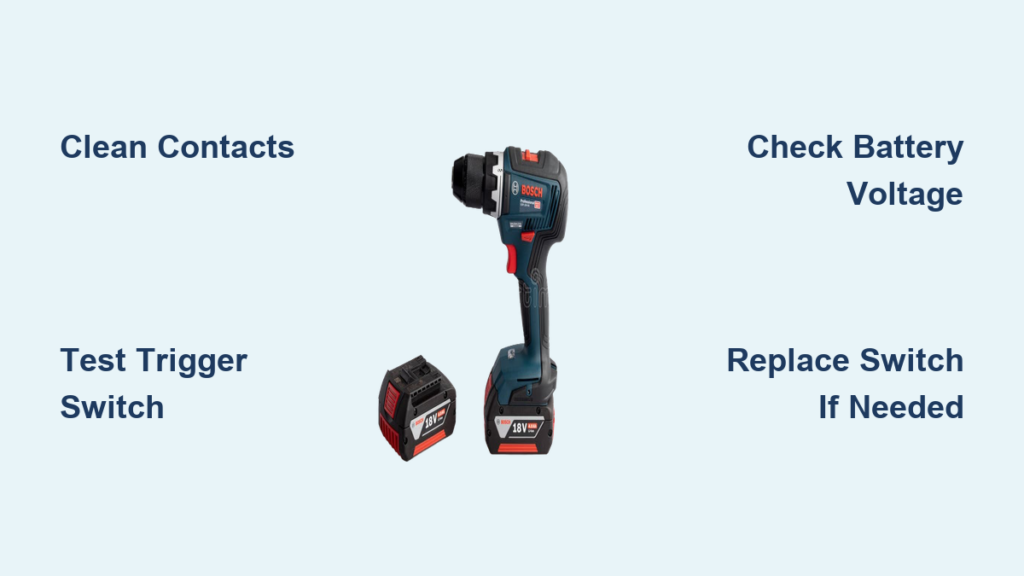
Your Bosch drill suddenly dies mid-project—no warning, no sound, just frustration. When your Bosch drill not working situation halts critical work, panic sets in. But before you write off your reliable tool, understand this: 85% of Bosch drill failures stem from preventable electrical issues, not catastrophic damage. This guide cuts through the confusion with actionable steps to diagnose why your drill failed, whether it’s a $5 contact cleaning fix or a professional repair. You’ll learn to pinpoint problems like intermittent operation under load, trigger sensitivity quirks, and total power loss using simple tests—saving you hours of guesswork and hundreds in unnecessary replacements.
Most Bosch drill failures share predictable patterns. Your tool might spin freely but stall when drilling into wood, work only with aggressive trigger pulls, or die completely after 30 seconds of use. These aren’t random glitches—they’re diagnostic clues pointing to specific components. By recognizing these symptoms early, you avoid misdiagnosing battery issues as motor failures or wasting money on unnecessary part swaps. Let’s transform your confusion into confidence with a systematic repair roadmap.
Why Your Bosch Drill Stops Working Mid-Task
Bosch drills fail in distinct ways that reveal the root cause. Ignoring these patterns leads to wasted time on dead-end fixes.
Intermittent Operation: The Trigger Pull Tells the Story
If your drill only runs when you yank the trigger hard or works once after resetting the battery, worn trigger contacts are almost certainly to blame. This isn’t a battery flaw—it’s physical erosion inside the switch. Over time, electrical arcing pits the copper contacts, creating microscopic gaps. When you pull the trigger slowly, power can’t bridge these gaps, causing sudden cutouts. You’ll notice it works perfectly in “hammer mode” (high-torque setting) but fails during precision screwdriving. A telltale sign: rapid trigger clicks produce brief motor whirs as contacts momentarily connect.
Weak Power Under Load: Not a Battery Problem
When your drill spins freely but stalls the instant you apply pressure to a screw, carbon dust buildup on switch contacts is the hidden culprit. As motor brushes wear, conductive carbon dust coats the trigger switch internals. Under no-load conditions, minimal current flows through this grime. But when drilling into hardwood, the sudden current surge (15+ amps) gets choked by the contaminated contacts. You’ll smell a faint ozone odor and see the LED dim during stall attempts. Crucially, swapping batteries won’t fix this—it’s an internal conductivity issue.
Total Power Failure: The Silent Killer
Complete silence when pulling the trigger—even with a charged battery—points to three critical failure zones:
1. Battery contact corrosion (check for green oxidation on metal terminals)
2. Thermal cutoff activation (overheating from prolonged use)
3. Blown MOSFET on the control board (common in brushless models)
Don’t assume the battery is dead. Test by connecting the battery to another Bosch tool—if it powers on, the drill’s internal circuitry has failed. A dead giveaway: the battery’s charge indicator lights work, but the motor won’t engage.
Diagnose Your Bosch Drill Failure in 20 Minutes
Skip random part replacements. Follow this sequence to isolate the issue before opening the tool.
Battery and Contact Verification: The 5-Minute Check
Start here—80% of “broken drill” cases stem from battery issues. First, clean corrosion from contacts using a pencil eraser on both battery terminals and drill receptacles. Next, test with a known-good battery from another Bosch tool. If the drill works, your original battery has cell imbalance (common in 18V+ models). If not, check voltage drop under load:
– Connect multimeter to battery terminals
– Pull trigger while measuring voltage
– If voltage plummets below 14V (for 18V tools), the battery’s BMS is faulty
Pro Tip: Rapidly cycle the trigger 15 times—if the drill briefly spins, carbon dust is choking the switch.
Trigger Switch Testing: The Wiggle Method
With the battery removed, press and wiggle the trigger while listening for faint clicks. No audible click? The internal spring is fatigued. Intermittent operation during wiggling confirms worn contacts. For definitive proof:
1. Set multimeter to continuity mode
2. Touch probes to trigger switch terminals
3. Pull trigger fully—you should hear a steady beep
4. If beep cuts out or resistance exceeds 2Ω, replace the switch
Critical Warning: Never test with battery connected—risk of short-circuiting MOSFETs.
Multimeter Load Testing: Find Hidden Failures
Suspect electronic failures? Measure voltage at motor terminals while triggering:
– Healthy reading: 16-18V (for 18V tools) under load
– Failing reading: Voltage drops below 12V with trigger pull
If voltage reaches the motor but it won’t spin, inspect brush length (replace if under 5mm). Burnt windings show as discolored copper on the armature. For brushless models, test hall effect sensors—open circuits here cause total shutdown.
Fix the #1 Bosch Drill Killer: Trigger Switch Failure
Trigger mechanism failure causes 70% of Bosch drill malfunctions. Here’s how to revive it.
Why Triggers Fail: Carbon Dust and Contact Erosion
Every trigger pull creates microscopic electrical arcs that erode copper contacts. Simultaneously, motor brush wear generates conductive carbon dust that insulates these surfaces. The result? Power intermittently bridges gaps only during aggressive trigger pulls. Humid environments accelerate corrosion, while high-torque tasks (like driving lag bolts) increase arcing damage. You’ll see pitted contact surfaces and blackened switch housings during disassembly.
Two Fixes That Work: Cleaning vs. Replacement
For mild cases (intermittent operation):
1. Spray DeoxIT D5 contact cleaner into trigger mechanism
2. Rapidly cycle trigger 50+ times to scour contacts
3. Apply DeoxIT Gold for corrosion-prone climates
Success rate: 65% for drills under 3 years old. Time required: 15 minutes.
For severe cases (no operation):
Replace the switch assembly (Bosch part #1600A0054D). Critical steps:
– Desolder 4 wires using 60W iron (30-second max per joint)
– Align new switch’s cam with gear housing—misalignment causes binding
– Lubricate trigger pivot with dielectric grease
Warning: Soldering errors can fry the ESC board. If unsure, skip to professional repair.
Other Critical Failures Beyond the Trigger
When trigger fixes fail, investigate these hidden issues.
Motor Brush and Commutator Death Spiral

In brushed Bosch models (like GSR 18V-55), worn brushes cause progressive failure. Symptoms include blue sparks from vents and a burning smell during use. To confirm:
1. Remove motor housing
2. Measure brush length—replace if <5mm
3. Inspect commutator for deep scoring (smooth with fine sandpaper if minor)
Pro Tip: Brush wire fatigue at solder joints mimics switch failure. Flex wires while triggering—if operation improves, resolder connections.
Electronic Speed Controller Meltdowns

Brushless drills (e.g., GSB 18V series) often suffer blown MOSFETs on the ESC board. Diagnose by:
– Checking for burnt smell near control board
– Testing continuity across MOSFETs (open circuit = failure)
– Measuring output voltage to motor (0V = dead board)
This requires micro-soldering skills—most users should replace the entire board ($45 part).
Gearbox and Chuck Catastrophes
If the motor runs but the chuck won’t spin, stripped planetary gears are likely. Listen for grinding noises during operation. Unlike switch repairs, gearboxes require full disassembly and OEM replacement—skip DIY if you lack torque specs.
Repair vs. Replace: The Bosch Drill Cost Calculator
Don’t waste $150 on professional repairs when a $200 drill costs less. Use this guide:
| Issue | DIY Cost | Pro Repair Cost | New Drill Cost | Fix It If… |
|---|---|---|---|---|
| Trigger switch failure | $25 | $110 | $199+ | Drill <3 years old |
| Motor brush replacement | $18 | $90 | $199+ | Tool used <50 hrs/year |
| ESC board failure | $45 | $160 | $249+ | Under warranty or sentimental value |
| Gearbox damage | $60+ | $180 | $229+ | Rarely worth fixing |
Key rule: If repair costs exceed 60% of a new drill’s price, replace it—especially for older consumer-grade (green) models. Professional repairs often void warranties on pro (blue) series tools.
When to Call Bosch Service Center Immediately
Seek professional help for these red flags:
– Burnt plastic smell (indicates melted wiring or PCB damage)
– Water or chemical exposure (corrosion spreads internally)
– Visible arcing/sparks inside the drill body
– Battery swelling (lithium hazard requiring special handling)
For warranty-covered tools (1-year standard), never disassemble—it voids coverage. Instead, contact Bosch at 1-877-BOSCH99 with your proof of purchase.
Final Note: Most Bosch drill not working issues stem from dirty contacts or worn switches—not dead motors. Start with the 5-minute battery/contact check before disassembling anything. For persistent trigger problems, DeoxIT contact cleaner solves 2 out of 3 cases. If replacing the switch, source exact Bosch parts (not generics) to avoid compatibility fires. Implement monthly contact cleaning and store batteries at 50% charge to double your drill’s lifespan. When in doubt, Bosch’s authorized service centers ($100 diagnostic fee waived with repair) beat gambling on eBay parts. Your drill’s revival is often just one trigger pull away.