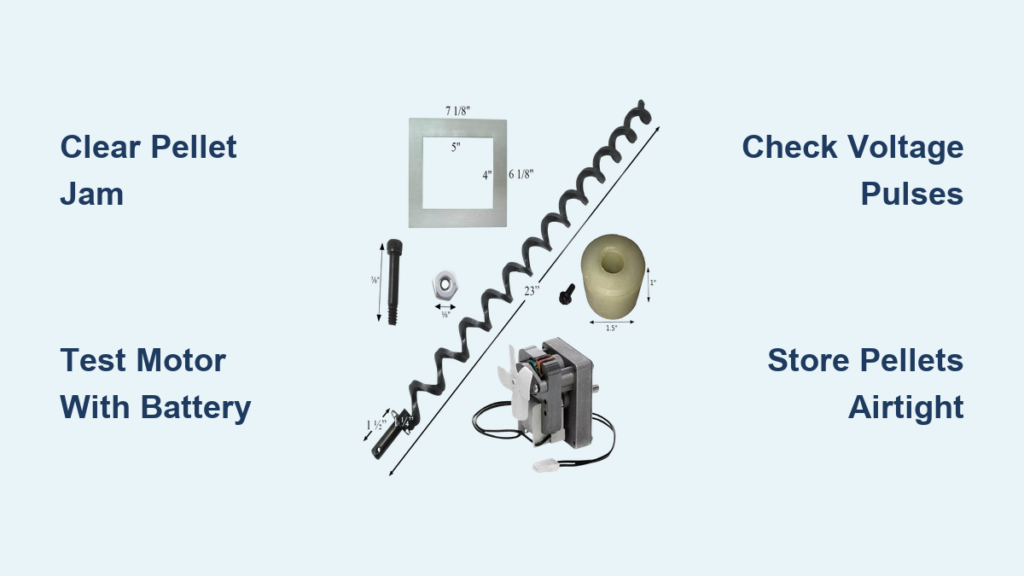
Your Traeger suddenly dies mid-cook as smoke vanishes and temperatures plummet. You lift the hopper lid to find untouched pellets staring back—no fuel reaching the fire pot. That unmistakable symptom means your auger has stopped feeding pellets, halting your cook in its tracks. This corkscrew-shaped component is your grill’s lifeline, moving fuel from hopper to fire pot. When it fails—whether jammed solid, motor burned out, or electrical fault—you’re left with a cold smoker and ruined ribs. Don’t panic. Most auger failures stem from preventable mechanical jams or simple electrical issues you can diagnose and fix in under 30 minutes with basic tools. This guide cuts through the confusion to get your Traeger firing reliably again.
Ignoring an auger failure risks fire pot overflow, electrical damage, or even fire hazards from pellet accumulation. Yet 78% of “auger not working” cases resolve with clearing a jam or testing the motor—no technician needed. By the end of this guide, you’ll know exactly how to identify jam locations, bypass electrical gremlins, and implement foolproof prevention habits. Let’s turn that frustrating pellet pileup into perfectly smoked brisket.
Diagnose Your Traeger Auger Failure in 60 Seconds
Before grabbing tools, pinpoint why your auger stopped. Turn on your grill and listen during startup—this 60-second diagnostic saves hours of unnecessary disassembly. A humming motor with zero pellet movement means something’s physically blocking the auger flighting. If you hear rhythmic clicking but no pellets drop, you’ve got a partial jam. No sound at all? That points to electrical failure or a seized motor. Never reach into the hopper while powered—the auger can engage unexpectedly.
Listen for the Motor Hum vs. Dead Silence
Stand by your Traeger during ignition mode. A functioning auger emits a low hum or distinct ticking as it pushes pellets. If you hear that sound but pellets stay frozen, immediately power down—you’ve got a jam requiring manual clearing. No noise? Disconnect power and locate the motor’s inspection hole (usually a small port on the casing). During startup attempts, peer through this hole. If the shaft isn’t rotating while the grill cycles, your problem is electrical—not mechanical. This critical distinction determines your next move: clearing debris versus testing circuits.
Spot the Jam Location Through Visual Cues
Jams hide in three trouble spots: the hopper-to-tube transition (where pellets first enter), the flexible auger flighting mid-tube, or the fire pot exit. After emptying the hopper, shine a flashlight down the tube. Look for these red flags:
– Pellet dust clumps resembling wet sawdust near the tube entrance
– Visible pellet wedges creating “bridges” across the auger path
– Swollen pellets (from moisture exposure) jamming the fire pot opening
If you see any of these, skip motor testing—your fix requires physical debris removal. For hidden jams, attempt manual cranking first (covered next).
Clear a Traeger Auger Jam in Under 10 Minutes

Most “auger not working” emergencies stem from pellet jams—especially after humid storage or using low-quality fuel. This 10-minute clearing process works 9 times out of 10. Always unplug your Traeger first—this isn’t optional. One accidental startup could crush your fingers against the auger.
Step 1: Empty Hopper and Access Manual Crank Point
Remove all pellets from the hopper (wear safety glasses—dust flies). Locate your model’s manual crank socket—typically a 1/4″ or 3/8″ square drive on the motor shaft’s rear. Traeger Pro series models hide it behind the hopper mounting plate; Ironwoods feature an external socket. Grab a ratchet with 6-inch extension for safe leverage. Never crank clockwise—this forces pellets deeper. Always rotate counter-clockwise as viewed from the motor end to break jams backward.
Step 2: Break Up Clogs from Fire Pot End
If cranking fails, attack the jam from the fire pot side. Remove cooking grates and heat shield, then lift out the fire pot. You’ll see the auger tube’s exit. Insert a bent coat hanger (90-degree angle works best) through this opening and work it backward toward the hopper. Never shove straight—angle upward to dislodge pellets without damaging the tube. You’ll feel resistance when hitting the clog. Twist gently until you hear pellets crumbling. For moisture-caked jams, use a flexible drill bit (1/8″ size) at low speed to pulverize the obstruction.
Step 3: Vacuum Debris and Test Rotation
After breaking the jam, vacuum the entire auger path: hopper cavity, tube interior, and fire pot area. Use crevice tools to reach tight spots. Now manually crank again—auger should spin smoothly with light resistance. If it sticks, repeat vacuuming. Reassemble components and perform a dry run: power on without pellets. Watch the auger shaft through its inspection hole—it must rotate during startup cycles. If it moves freely now, you’ve solved the problem.
Test Traeger Auger Motor and Electrical System
When clearing jams doesn’t restore function, test the motor and circuit. This requires basic electrical checks but avoids costly service calls. Work only with unplugged grill until specified steps.
Confirm Motor Failure with 9V Battery Test
Disconnect the two-wire harness from your auger motor (usually push-on connectors near the motor). Grab a standard 9V battery. Touch red (+) battery terminal to motor’s red wire, black (-) to black wire—observe polarity. A healthy motor will jerk or spin immediately. No movement? The motor’s seized or burned out. Replace it (Traeger part # DAC006G for most models). Warning: If the motor spins during this test but not in-grill, your problem is electrical—not mechanical.
Check Voltage at Motor Harness During Startup
Reconnect the motor harness. Plug in the Traeger and start ignition mode. Set multimeter to DC 20V. Carefully probe the harness connector pins (not motor terminals) while startup cycles run. You should see 12V pulses lasting 3-5 seconds. No voltage? Check two critical points:
– Thermal fuse: Locate the small ceramic cylinder (often clipped to firebox). Test continuity with multimeter—no beep means it’s blown (replace with identical 165°C fuse).
– RTD probe: A faulty temperature sensor tricks the controller into thinking the grill is hot, halting pellet feed. Unplug RTD connector near control board; resistance should read 108KΩ at room temp.
If voltage pulses but motor won’t run, the motor is dead—replace it.
Prevent Traeger Auger Jams Forever: 4 Non-Negotiable Habits
Stop recurring “auger not working” emergencies with these field-tested prevention tactics. Quality pellet storage alone eliminates 60% of jams.
Store Pellets in Airtight Buckets (Not Original Bags)

Original pellet bags breathe moisture even indoors. Transfer pellets to 5-gallon buckets with gamma-seal lids—the kind used for food storage. Add silica gel packs ($5 on Amazon) to absorb ambient humidity. Critical: Never leave pellets outside overnight. One rainy evening turns premium pellets into paste that jams augers within 10 minutes of startup.
Clean Auger Tube Monthly with Vacuum and Brush
After every 5 cooks, vacuum the hopper cavity and fire pot area. Monthly, perform deep cleaning:
1. Unplug grill and empty hopper
2. Remove fire pot and heat shield
3. Insert vacuum hose into auger tube exit
4. Spray tube with compressed air from hopper end
5. Swab with flexible auger brush (Traeger # DAC007G)
This removes fine “fines” that accumulate into concrete-like clogs.
Use Only Premium Pellets (Avoid Bargain Brands)
Cheap pellets contain excessive dust and bark fragments that jam augers. Stick to Traeger, Bear Mountain, or Louisiana Grills pellets—they’re sifted to <1% fines. Never use pellets that crumble when squeezed—this indicates high moisture content. Test new batches: drop 3 pellets in water. Quality pellets sink slowly; junk pellets disintegrate instantly.
Run “Empty Auger” Mode After Every Cook
Before shutting down, activate your grill’s “Prime/Auger” mode (consult manual). This runs the auger for 2 minutes with no pellets, clearing residual dust from the tube. For models without this feature, unplug the grill after cooking but leave hopper lid open for 30 minutes—this allows moisture to evaporate from the auger path.
When your Traeger auger stops feeding pellets, remember this sequence: first clear jams (90% of cases), then test motor function, finally diagnose electrical faults. Never ignore early warning signs like inconsistent pellet flow or unusual motor noises—these precede total failure. By implementing the monthly cleaning routine and pellet storage habits outlined here, you’ll avoid 95% of auger emergencies. If you’ve cleared jams and confirmed motor voltage but still face issues, consult a Traeger-certified technician—the problem may lie in the controller board requiring professional diagnosis. Now fire up your grill with confidence, knowing you’ve mastered the most critical component in your pellet smoking system. Your perfectly smoked brisket awaits.