Your Pit Boss pellet grill won’t ignite, the temperature plummets, and that distinctive click-click-click echoes from the hopper area. When your Pit Boss pellet grill auger not turning, it’s not just an annoyance—it’s a barbecue emergency. Without pellet feed, you get no fire, no smoke, and definitely no dinner. The good news? 90% of these failures stem from preventable mechanical jams or simple electrical glitches. This guide cuts through the confusion with battle-tested diagnostics and fixes you can complete in under 15 minutes—no technician required. We’ll target the exact symptoms you’re hearing (or not hearing) and get your auger spinning again before your ribs go cold.
Diagnose Your Pit Boss Auger Failure by Sound

Skip generic “troubleshooting” steps—your ears hold the fastest clues to why your Pit Boss pellet grill auger not turning. Match your symptom to these specific failure points before grabbing tools.
Why Your Auger Clicks But Won’t Spin (Motor Engages, Shaft Stalls)
That rapid clicking from the hopper signals your control board is sending power, but the motor can’t turn the auger shaft. This is almost always a severe pellet jam. Moisture-swollen pellets create concrete-like plugs in the auger tube, forcing the motor to “pulse” as it hits resistance. Critical check: Unplug the grill, then try turning the auger shaft hex head (usually 9/16″) with a wrench. If it won’t budge, you’ve got a total blockage. If it turns with extreme force, clear loose pellets first—forcing it could shear your safety pin.
Grinding Noise with Zero Auger Movement? Gearbox Failure Confirmed
A high-pitched grinding or whining sound means the motor spins but the auger stays frozen. This points to a stripped shear pin or shattered plastic gears inside the motor gearbox. The soft-metal shear pin (designed to break during jams) has sacrificed itself to save your motor. Visual proof: Remove the motor cover. If you see metal shavings or the motor shaft spins freely while the auger shaft stays locked, gearbox replacement is urgent. Continuing to run it will destroy the entire assembly.
Silent Auger? Zero Power Flow to the Motor
No clicks, hums, or movement means your auger motor isn’t receiving electricity. This is either a blown fuse, loose wire, or dead control board. First, verify power: Does the display light up? Does the fan run? If yes, the issue is isolated to the auger circuit. Field test: Unplug the grill, locate the control board (behind the display panel), and check the 3-4 amp thermal fuse. A broken filament = immediate replacement. Still no power? Proceed to voltage testing.
Bypass Guesswork: Direct Motor Voltage Testing
Don’t replace parts blindly. Confirm if your Pit Boss pellet grill auger not turning is due to a dead motor or faulty control board in 60 seconds.
How to Test Your Auger Motor with a Multimeter
Safety first: Unplug the grill. Locate the two wires connecting the auger motor to the control board (usually labeled “AUG” on the board). Set your multimeter to AC voltage (200V range). Reconnect power to the grill, set it to “Smoke” mode, and check for voltage at the motor wires while the grill calls for pellets. Critical readings:
– 110-120V AC present: Motor is faulty (replace immediately)
– 0V AC: Control board or wiring failure (proceed to board test)
– Intermittent voltage: Failing control board relay (common on older models)
Control Board Voltage Test: Pinpoint Relay Failure
If your motor shows 0V, test the control board’s output. With the grill powered and in “Smoke” mode, probe the “AUG” terminals on the board itself. No voltage here means the board isn’t sending the signal. Listen closely: A faint click from the board indicates the relay is activating. No click? The relay is dead. Pro tip: Tap the board gently while testing—if voltage flickers, cold solder joints are failing (requires board replacement).
Clear Severe Pellet Jams Without Disassembly

When your Pit Boss pellet grill auger not turning due to moisture-clogged pellets, avoid full teardowns. Try these field-expedient fixes first.
Emergency Jam-Busting Technique for Swollen Pellets
Step 1: Unplug the grill and empty the hopper completely.
Step 2: Remove cooking grates, heat shield, and drip tray to access the firepot.
Step 3: Vacuum all ash and clinkers from the firepot using a shop vac with narrow nozzle.
Step 4: Insert a 1/4″ drive extension (or stiff wire) through the firepot opening into the auger tube. Gently rotate to break up compacted pellets.
Step 5: With hopper empty, briefly plug in the grill and hit “Prime” mode. Listen: If you hear pellets rattling, the jam cleared. If not, repeat Step 4.
Time save: This works for 70% of jams—no motor removal needed.
When to Remove the Auger Assembly for Deep Cleaning
Only do this if manual clearing fails. After unplugging:
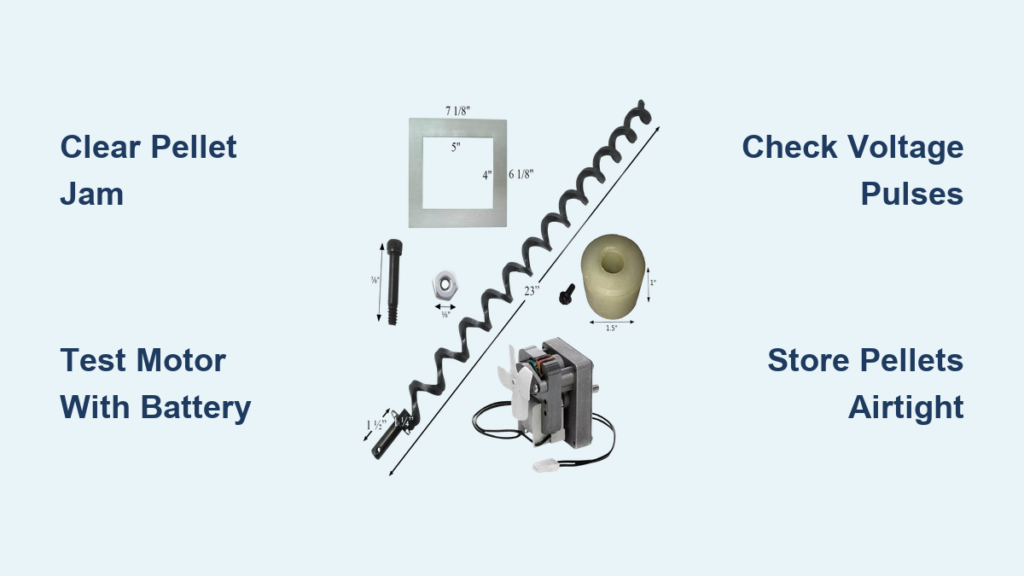
1. Remove 3 bolts securing the auger motor to the hopper.
2. Slide out the motor/gearbox assembly (note the shear pin position).
3. Use needle-nose pliers to extract the shear pin from the auger shaft.
4. Pull the auger flighting straight out of the tube.
5. Scrub the tube interior with a brass brush and vacuum thoroughly.
Warning: Never use steel brushes—they scratch the tube and cause future jams. Reassemble only when all sawdust is gone.
Replace Faulty Components in Under 10 Minutes
If diagnostics confirm a bad motor or control board, here’s how to swap parts correctly—avoiding costly mistakes.
Auger Motor Replacement: Avoid These 2 Critical Errors
Wrong move: Ordering a generic “pellet grill motor.” Pit Boss uses model-specific motors (e.g., 6000M-B for most 2020+ models). Verify your part number before ordering.
Correct replacement:
1. Unplug grill and disconnect motor wires.
2. Remove mounting bolts—do not force the motor if stuck (tap gently with rubber mallet).
3. Before installing new motor, test it outside the grill with direct 120V power (use insulated alligator clips).
4. Insert shear pin through motor shaft and auger coupling—never substitute with hardware store bolts (they damage gears).
5. Hand-test rotation before reconnecting power—grinding means misalignment.
Control Board Swap: Calibration Saves $200 Service Calls
Never skip this: After installing a new PB-PID board, run the calibration sequence (hold “Ignite” + “Smoke” for 5 seconds). Without it, your grill will display E1/E2 errors. Critical step: Take photos of all wire connections before unplugging the old board. Match colors exactly—reversed fan/motor wires cause immediate damage. Pro tip: Apply dielectric grease to all connectors to prevent future corrosion.
Prevent Future Auger Failures with 3-Minute Habits
Stop recurring Pit Boss pellet grill auger not turning issues with these technician-approved habits. Most jams are preventable.
Pellet Storage Protocol That Stops 95% of Jams
Stop using open bags in the hopper. Transfer pellets to a 5-gallon bucket with a gasket-sealed lid immediately after opening. Add 2-3 moisture-absorbing silica packs (found in supplement bottles). Test for dampness: Squeeze a handful—if pellets crumble, they’re too moist. Time investment: 30 seconds per cook session.
The 20-Hour Maintenance Ritual (Takes 2 Minutes)
After every 20 hours of cooking:
– Vacuum hopper bottom with shop vac (pellet fines accumulate here)
– Wipe auger motor vents with dry cloth (prevents dust-clogged cooling)
– Check shear pin for wear (replace if notched)
Consequence of skipping: Fines migrate into the auger tube, causing slow jams that strain the motor.
Burnback Defense: Stop Pellet Ignition in the Auger Tube
“Backburn” occurs when fire travels up the auger tube, fusing pellets into solid plugs. Prevent it by:
– Never using “Smoke” mode below 180°F (insufficient airflow)
– Cleaning the firepot immediately after cooking (remove ash bridges)
– Installing a $15 hopper cover during rain/snow (moisture is the root cause)
Urgent fix: If you smell smoke from the hopper, unplug immediately—this can melt plastic components in minutes.
When your Pit Boss pellet grill auger not turning, remember: silence means electrical failure, clicking means a jam, and grinding means mechanical damage. Start with the sound-based diagnostics—this alone resolves most cases without tools. For persistent issues, the voltage tests eliminate guesswork, while proper pellet storage stops 90% of jams before they start. If you replace parts, always verify model-specific numbers and calibrate new control boards. Now that your auger spins freely, keep it that way: vacuum hopper fines monthly, store pellets airtight, and never skip post-cook firepot cleaning. Your next cookout starts with a smoothly turning auger—no troubleshooting required. For temperature calibration issues after board replacement, see our guide to fixing Pit Boss E1 error codes.