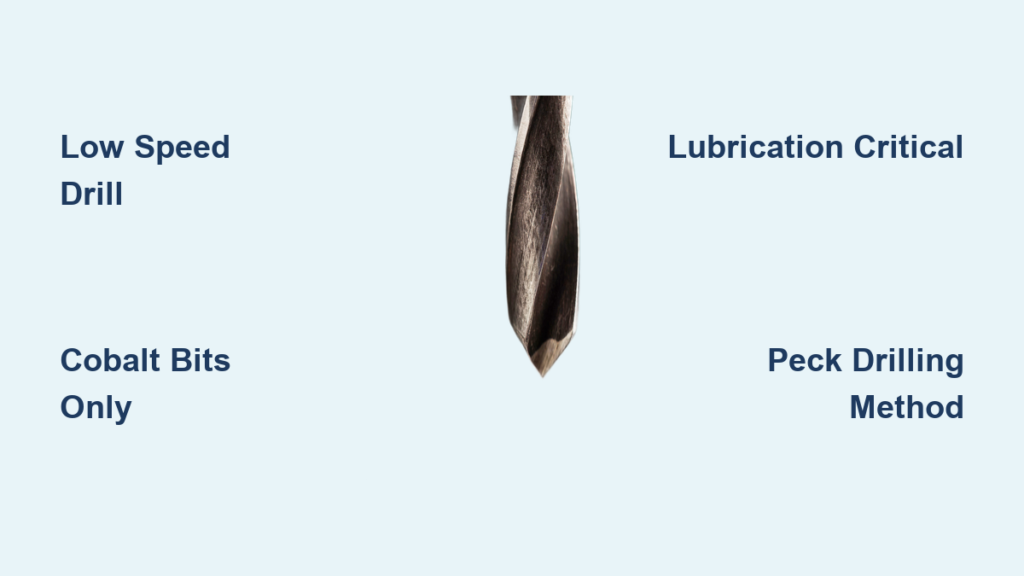
You’ve lined up your drill, pressed the trigger, and watched in frustration as the bit spins uselessly against the stainless steel surface. Instead of cutting cleanly, it creates a blue-tinged dimple that’s now harder than your drill bit. This isn’t a failure of your tools—it’s stainless steel’s infamous work hardening in action. Unlike mild steel, stainless alloys like common 304 and 316 transform under heat and pressure, creating an impenetrable barrier that destroys drill bits. But with the right approach, you can drill clean, precise holes consistently. This guide reveals the exact techniques professionals use to conquer stainless steel, covering critical speed settings, lubrication tricks, and step-by-step methods that prevent work hardening. You’ll learn why standard drilling fails and how to achieve flawless results whether you’re working with thin sheet metal or thick plates.
Why Standard Drilling Fails on Stainless Steel
Stainless steel’s corrosion resistance comes from chromium, but this same property creates drilling nightmares through rapid work hardening. When you apply excessive speed or insufficient lubrication, friction generates intense localized heat that alters the metal’s crystalline structure. Within seconds, the area around your drill point becomes harder than high-speed steel bits—a self-defeating cycle where the material you’re cutting literally strengthens against your tool. This explains why stainless steel feels “gummy” during drilling; instead of producing clean metal curls, you get powdery chips or no cutting at all. The critical mistake most DIYers make? Treating stainless like regular steel. Its thermal conductivity is only one-third that of carbon steel, meaning heat stays concentrated at the drill point instead of dissipating. Without controlled speeds and constant cooling, you’ll create a hardened zone that stops even cobalt bits cold.
Essential Tools That Actually Work on Stainless Steel

Skipping these tools guarantees failure. Your standard hardware store bits won’t survive three seconds on stainless steel—invest in these proven solutions:
- Cobalt or Carbide Drill Bits: Standard HSS bits dull instantly. Use M42 cobalt bits (8% cobalt content) as the absolute minimum—they withstand 1,000°F temperatures where HSS fails. For frequent work, upgrade to carbide-tipped bits; they cut through work-hardened spots but require careful handling to avoid chipping.
- Center Punch with Sharp Tip: Not the blunt hardware store version. A 30-degree point punch creates the deep, narrow starter dimple that prevents “bit walk.” Strike firmly with a ball-peen hammer—your dimple must be twice as deep as on mild steel.
- Specialized Cutting Fluid: Water won’t cut it. Use sulfo-chlorinated tapping fluid like Tap Magic, dark-thread cutting oil, or the surprisingly effective DIY solution: 1 tablespoon dish soap + ½ teaspoon bleach per pint of water in a spray bottle. This emulsifies heat and flushes swarf.
- Variable-Speed Drill Press (Strongly Recommended): Hand drills struggle with consistent low RPMs. If using handheld, choose a corded model with a dedicated low-speed gear (0-600 RPM range). Cordless drills often lack torque at critical low speeds.
Step-by-Step Drilling Process That Prevents Work Hardening
Creating an Unshakeable Starting Point
Skip this step and your bit will wander every time. First, mark your hole location with a scribe for precision—pencil marks slip. Then position your sharp center punch dead-center on the mark. Hold the punch vertically and strike with a single firm hammer blow to create a deep conical dimple. For critical holes, add a secondary micro-dimple inside the first using a prick punch. This creates a “landing zone” that guides the drill bit’s chisel point. Test your dimple by placing the drill bit tip in it—your bit shouldn’t roll when tilted 30 degrees.
Mastering Speed and Pressure for Clean Cuts
This is where 90% of failures occur. Your drill’s high-speed setting is the enemy. For a 3/16″ bit, maintain 400 RPM—about the speed of a slow kitchen mixer. Larger bits require slower speeds: 1/4″ bits need 250 RPM, while 1/2″ bits demand just 100 RPM. Here’s how to gauge success:
– ✅ Perfect cut: Thin, continuous silver coils of metal
– ❌ Too fast: Blue discoloration on metal + powdery chips
– ❌ Too slow: Squealing noise + no chip formation
Apply firm, unwavering pressure—enough to see your drill motor labor slightly. If the bit stops cutting, immediately retract it; continuing work-hardens the spot. Let the sharp bit do the work; never “lean in” to force progress.
Lubrication and Peck Drilling Technique
Before starting, flood the dimple with cutting fluid until it pools. Begin drilling at your preset low RPM with steady pressure. After 2-3 seconds (or when the bit penetrates 1/8″), completely withdraw it while keeping the drill spinning. Wipe away metal shavings with a rag, reapply fluid generously, then resume drilling. Repeat this “peck cycle” every few seconds—never drill deeper than the bit’s diameter without clearing chips. As you approach breakthrough (when light appears through the hole), reduce pressure to 25% of original force. This prevents the bit from grabbing and tearing the exit edge.
Drilling Large Holes Without Tear-Out
Holes over 1/4″ require strategic step-drilling. Start with a 1/8″ pilot hole using the cobalt bit technique. For a 1/2″ final hole, progress through 3/16″ and 1/4″ sizes, lubricating at each stage. For holes over 3/4″:
– Use step drill bits for sheet metal under 1/8″ thick: They cut progressively without pilot holes but require constant fluid application
– Employ carbide-grit hole saws for thick material: Drill a 1/8″ pilot hole first, then use the hole saw at 150 RPM with heavy fluid flow. Never force it—let the grit do the cutting
– Switch to annular cutters for precision: These expensive but efficient cutters produce burr-free holes in one pass with a drill press
Troubleshooting Critical Drilling Failures

When Your Bit Spins But Won’t Cut
Cause: You’ve created a work-hardened zone. The stainless steel surface now measures 50+ HRC hardness—harder than your drill bit.
Immediate action: Stop drilling immediately. Apply ice packs to cool the area, then try one solution:
1. Use a new carbide bit at 50% slower speed with extra fluid
2. Move 1/4″ away and restart with a fresh center punch
3. For stubborn spots, use a carbide ball end mill to mill out the hardened area
Preventing and Fixing Bit Wander
Cause: Shallow dimple or misaligned drill.
Solution: Redo your center punch with a sharper tip (60-degree angle) and deeper strike. When starting the drill, begin at 200 RPM with heavy downward pressure for the first 2 seconds—this “bites” the bit into the dimple before increasing speed.
Eliminating Squealing and Smoke
Cause: Critical heat buildup from excessive speed or dried lubricant.
Solution: Stop within 3 seconds of hearing squealing. Let the bit cool completely in water (not oil), then reapply fluid. Check bit sharpness—replace if the cutting edge shows any blue discoloration. Always maintain fluid coverage; reapply every peck cycle.
Professional Shortcuts for Flawless Results

The soap-bleach coolant trick: This DIY mixture cools 40% better than water alone. The soap reduces surface tension for better penetration, while bleach prevents bacterial growth in your spray bottle. Keep it in a labeled container—never use near food prep areas.
Drill bit sharpening secret: Cobalt bits dull faster on stainless than regular steel. After every 3-5 holes, refresh the cutting edge with a diamond stone. Focus on maintaining the original 135-degree point angle—flatter angles increase work hardening risk.
Breakthrough technique for thin metal: When drilling sheet under 1/16″ thick, place a wood scrap behind the workpiece. As the bit exits, it cuts into the wood instead of grabbing the thin metal edge, preventing jagged tear-out.
Vibration killer: Clamp your workpiece to a concrete block or sandbag. Any movement during drilling creates chatter that instantly work-hardens stainless. For handheld drilling, brace your elbow against your hip for stability.
Mastering stainless steel drilling hinges on respecting its unique properties. By prioritizing low speeds (never exceeding 500 RPM), maintaining aggressive lubrication, and using cobalt or carbide bits exclusively, you’ll transform frustrating failures into predictable success. Remember the golden rule: if you hear squealing or see blue discoloration, stop immediately—continuing guarantees a ruined hole. With these techniques, even 316 marine-grade stainless yields clean holes on your first attempt. For ongoing projects, keep your cutting fluid accessible and always start with a freshly sharpened bit; your patience will be rewarded with professional-grade results every time.