You’re in the middle of a critical home project when your cordless drill suddenly dies, and you realize your charger is missing, broken, or simply nowhere to be found. This frustrating scenario happens to DIYers and professionals alike. While the safest approach is always using the manufacturer-approved charger, there are legitimate emergency methods to charge a drill battery without charger access when you absolutely must finish your task. This guide reveals the safest alternative charging techniques while emphasizing the critical safety protocols that could prevent a fire or explosion in your workshop.
Before attempting any alternative charging method, you must understand that improper charging is the leading cause of power tool battery fires. Lithium-ion batteries—common in modern 18V-20V MAX systems—can enter thermal runaway within seconds if mishandled, creating an intense fire that’s extremely difficult to extinguish. This guide focuses on practical solutions while prioritizing your safety above all else.
Identify Your Drill Battery Chemistry Before Charging (Critical First Step)
Your battery’s chemistry determines whether emergency charging is even possible and which methods are safe. Using the wrong approach could destroy your battery or cause a dangerous incident.
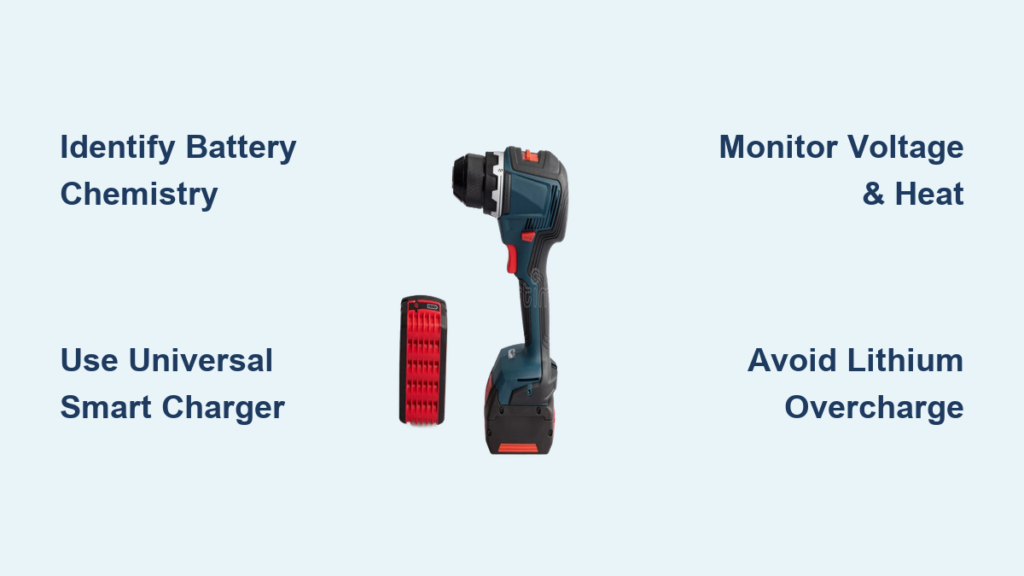
Lithium-ion (Li-ion) Batteries: These power most modern 18V-20V MAX drill systems. They require precise Constant Current (CC) followed by Constant Voltage (CV) charging at exactly 4.2V per cell. Never attempt to charge swollen, punctured, or damaged Li-ion batteries—dispose of them properly at a recycling center. If you’re wondering how to charge a drill battery without charger for this common type, proceed with extreme caution as they have zero tolerance for voltage errors.
Nickel-Cadmium (NiCd) Batteries: Found in older or budget tools, these tolerate more charging “abuse” but suffer from memory effect if not fully discharged. They’re generally safer for emergency charging than Li-ion but still require monitoring.
Nickel-Metal Hydride (NiMH) Batteries: Less common in modern tools but still found in some systems. They require different voltage thresholds than NiCd but are more stable than Li-ion during alternative charging attempts.
5 Non-Negotiable Safety Steps Before Attempting Alternative Charging
Skipping these safety protocols when trying to charge a drill battery without charger could have catastrophic consequences.
Wear Proper Protective Gear: Safety goggles and non-flammable gloves aren’t optional. Lithium fires produce toxic fumes and can reach temperatures exceeding 1,100°F—enough to melt metal. Work in a well-ventilated area away from flammable materials.
Prepare Fire Containment: Place your battery in a fireproof container like a metal bucket filled with sand during charging. A Class D fire extinguisher (specifically for metal fires) must be within immediate reach—regular extinguishers won’t stop lithium fires. Never charge on wooden surfaces or near paper, rags, or solvents.
Never Leave Batteries Unattended: Thermal runaway can happen in seconds. Set a timer and check your battery every 5 minutes for heat, swelling, or unusual odors. If it becomes warm to the touch (not just slightly warm), stop charging immediately.
Verify Battery Condition First: Do not attempt to charge any battery showing physical damage—bulging, dents, leaks, or corrosion. These indicate internal damage that makes emergency charging extremely dangerous. When learning how to charge a drill battery without charger, damaged units should be recycled, not revived.
Check Ambient Temperature: Charging below 32°F (0°C) or above 104°F (40°C) significantly increases failure risks. Lithium-ion batteries charge most safely between 50-77°F (10-25°C). Cold batteries charge inefficiently, while hot batteries risk thermal runaway.
How to Safely Charge Your Drill Battery with a Universal Smart Charger

This method offers the safest alternative when you need to charge a drill battery without charger access, especially for occasional users.
Select the Right Universal Charger: Purchase a Tenergy Universal Smart Charger ($20-30) designed for Li-ion, NiMH, and NiCd batteries. These automatically detect battery chemistry and apply the correct charging profile—critical for preventing overcharging. Avoid cheap, no-name chargers without proper safety cutoffs.
Connect Properly to Avoid Catastrophe: Locate the positive (B+) and negative (B-) terminals on your battery pack. You may need to partially disassemble the casing to access them—never force connections. Use alligator clips to connect the charger leads to the correct terminals, ensuring polarity matches (red to positive, black to negative).
Monitor the Charging Process: Place the battery in a fireproof container during charging. Most universal chargers take 2-4 hours to fully charge a depleted drill battery. Watch for the charger’s indicator light changing from red (charging) to green (complete)—never leave it charging beyond this point. If the battery becomes warm or the charger behaves erratically, disconnect immediately.
Step-by-Step Guide: Charging Your Dewalt 20V Battery with a Bench Power Supply
This advanced method should only be attempted by those with electronics experience when you absolutely must charge a drill battery without charger.
Set Up Your Power Supply Correctly: For a Dewalt 20V battery (actually 18V nominal), set your bench power supply to 20.5V output with current limited to 1-2A maximum. Start with the current limit at 500mA—too much current can cause immediate damage. Connect positive (red) to B+ and negative (black) to B- with secure alligator clips.
Monitor Voltage and Temperature Continuously: As charging progresses, the voltage should rise slowly from about 18.2V (dead) to 20.5V (full). Use a multimeter to verify voltage every 5 minutes. Employ an infrared thermometer to check battery temperature—any reading above 113°F (45°C) means you must stop immediately.
Terminate Charging at the Right Moment: End the charge when current drops below 300mA or after 2 hours, whichever comes first. Never exceed 4.25V per cell—overcharging lithium batteries by even 0.1V can trigger thermal runaway. This method requires constant attention and should never be left unattended for even a minute.
How to Use Cross-Brand Adapters to Charge Your Drill Battery Without Original Charger
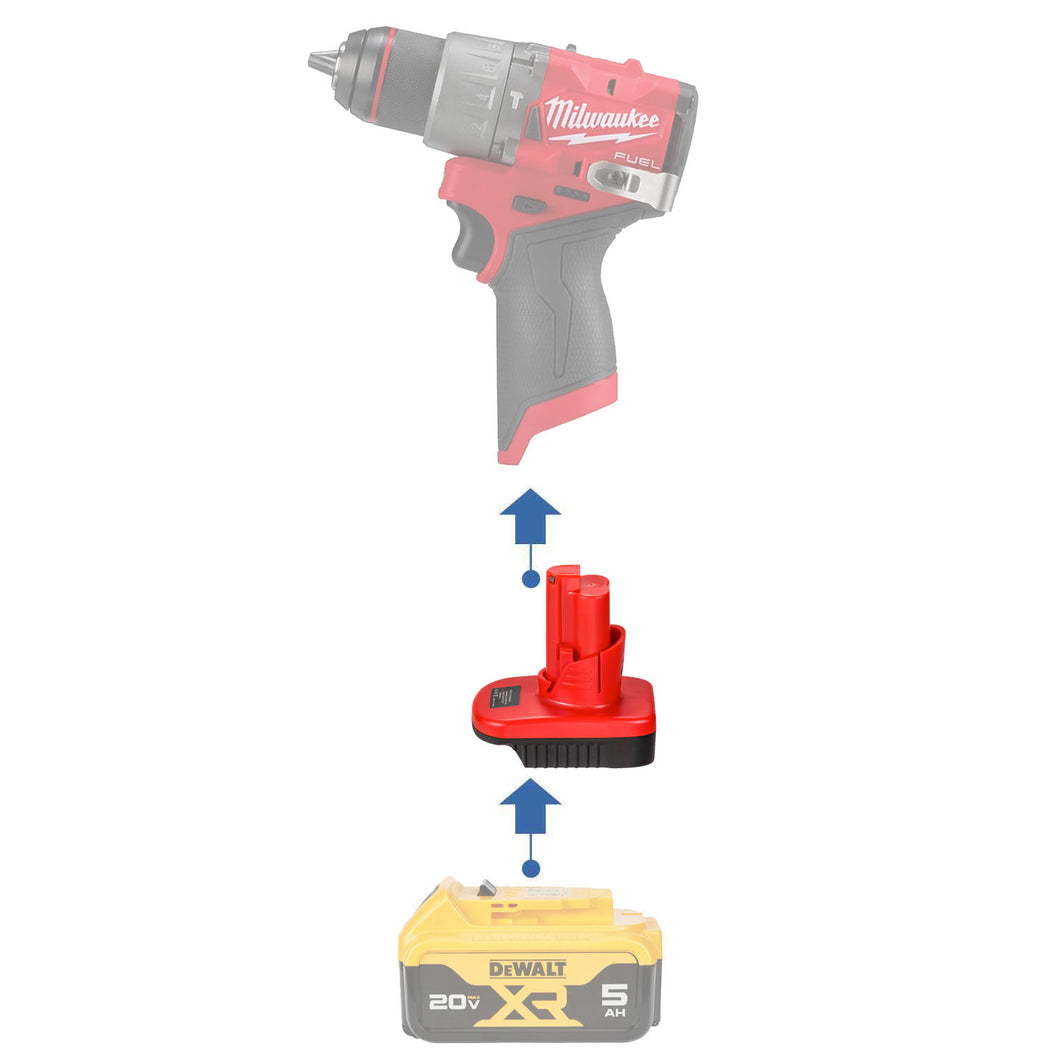
Many DIYers don’t realize compatible charging solutions exist across brand platforms when they need to charge a drill battery without charger.
Find the Right Adapter Sleeve: Commercial adapters like Milwaukee M12 to Dewalt 20V converters ($15-25) let you use a different brand’s charger. These maintain proper polarity and often include communication pins that prevent charging incompatible batteries. Verify adapter specifications match your battery voltage before purchasing.
Check Compatibility Thoroughly: Not all 18V/20V systems are interchangeable—some have different communication protocols. Research your specific models online to confirm compatibility. If the adapter feels loose or connections don’t align perfectly, do not force it—this could cause a short circuit.
Monitor the First Charging Cycle Closely: Even with compatible adapters, watch for excessive heat or unusual behavior during the initial charge. Most cross-brand charging works safely, but always prioritize safety over convenience when attempting to charge a drill battery without charger.
Using Your Car’s 12V System to Charge Older NiCd/NiMH Drill Batteries
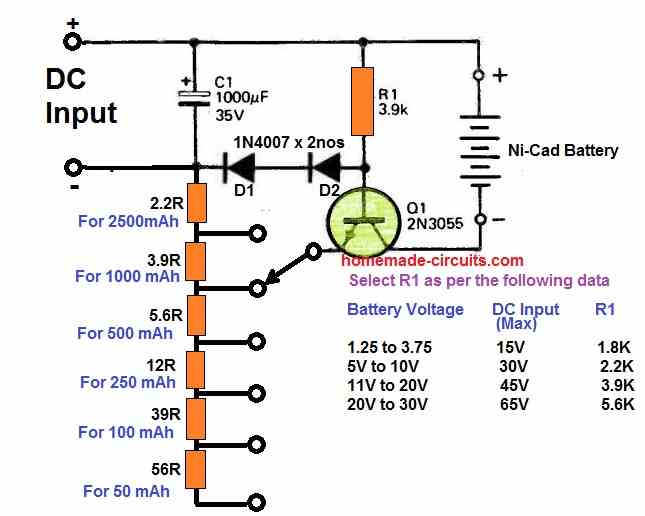
This method works only for older 12V NiCd or NiMH drill batteries—not for modern lithium systems.
Prepare a Safe Connection: Use alligator clips to connect your drill battery’s positive terminal to the car battery’s positive terminal, and negative to negative. Never attempt this with lithium batteries—the voltage mismatch can cause immediate fire. For 12V tool batteries (actually 10.8V nominal), the car’s 12.6V provides a safe charging voltage.
Limit Charging Time Strictly: Connect for no more than 30 minutes at a time, then check temperature. Older NiCd batteries require slow charging—this method delivers about C/10 rate. If the battery becomes warm, disconnect immediately and let it cool before continuing.
Never Leave Connected Overnight: Unlike proper chargers, your car battery provides unregulated voltage that can overcharge and damage NiCd/NiMH batteries if left connected too long. This emergency method should only provide enough charge to complete your immediate task, not a full replacement for proper charging.
When to Stop: Recognizing Danger Signs During Emergency Battery Charging
Knowing when to abort your attempt to charge a drill battery without charger could save your workshop from fire damage.
Immediate Warning Signs: Stop charging instantly if you notice any swelling, hissing sounds, chemical odors, or smoke. These indicate thermal runaway has begun—lithium fires can ignite within seconds once these symptoms appear. If this happens, move the battery to your sand container using long tools and cover it completely.
Temperature Thresholds: A battery should feel cool or only slightly warm during safe charging. If it’s too hot to touch comfortably (above 113°F/45°C), disconnect power immediately. Use an infrared thermometer for precise monitoring—many thermal runaways begin before a battery feels dangerously hot to the touch.
The One-Minute Safety Rule: If you’re ever uncertain whether to continue charging, disconnect and wait five minutes. A truly safe charging process won’t deteriorate significantly in that short time, while a developing thermal event will often show clear progression. When in doubt about how to charge a drill battery without charger safely, stop and purchase the proper equipment.
Final Recommendation: While these emergency methods can get you through a critical project, the only truly safe, reliable solution is purchasing a proper replacement charger ($20-80 depending on brand). The risks of fire, explosion, and voided warranties almost always outweigh the convenience of improvised charging. For frequent users, investing in a universal charger or spare OEM charger prevents these dangerous dilemmas entirely—your safety is worth far more than the cost of proper equipment.