
You’re tightening a vise on your drill press, about to bore a precise hole in hardwood, when the question hits: When was the drill press invented? That cast-iron machine humming under your hands seems timeless, but its origins are far from simple. Unlike the lightbulb or telephone, no single “eureka” moment defines this essential workshop tool. The truth is messier—and far more fascinating—than most DIYers realize.
For centuries, craftsmen struggled with handheld drills that wobbled, slipped, and ruined projects. The quest for controlled, vertical drilling sparked innovations across continents and eras, culminating in the machine you rely on today. Forget expecting one inventor or patent date; the drill press emerged through incremental breakthroughs spanning from medieval workshops to Industrial Revolution factories. By the time you finish this article, you’ll understand exactly why the question “when was the drill press invented” has no tidy answer—and which pivotal developments actually matter for modern users.
The 15th-Century Bow Drill: First Guided Drilling System
How European Manuscripts Reveal Early Precision Drilling
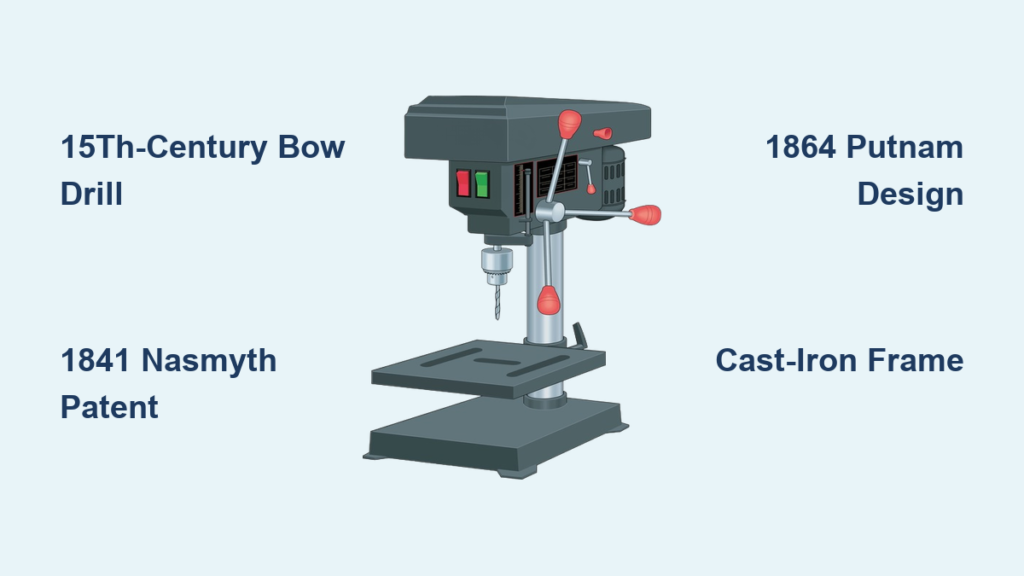
Long before electric motors or cast-iron frames, artisans achieved remarkable drilling accuracy using a deceptively simple system. Surviving European manuscripts from the 1400s depict the “bow drill press”—a guided mechanism where a taut bow’s back-and-forth motion rotated the drill bit. This wasn’t a handheld tool; it featured a fixed vertical frame anchoring the bit, ensuring perpendicular holes in wood or soft metals. Imagine a bowyer’s workshop: the craftsman secures material beneath the frame, loops a cord around the drill shaft, and glides the bow horizontally. Each stroke drives the bit downward with controlled force, eliminating the wobble that plagued freehand drilling.
Why This Ancient Design Was Revolutionary for Craftsmen
This 15th-century innovation solved a critical problem: consistency. For furniture makers or armorers creating repetitive components, the bow drill press delivered uniform hole depth and alignment impossible with hand drills. The fixed frame absorbed lateral forces, while the bow’s motion provided smoother torque than a pump-action “eggbeater” drill. Though limited to softer materials and requiring significant manual effort, it established the core principle every modern drill press relies on: mechanical guidance for vertical accuracy. Without this foundational concept, later metal-framed machines would never have evolved.
Industrial Revolution Sparks Demand for Precision Metal Drilling

How Steam Engines Forced Drill Press Innovation
The rise of steam-powered machinery in the early 1800s created an urgent, unmet need: drilling perfectly aligned holes in iron and steel components. Early steam engines, locomotives, and textile mills demanded precision-fitted pistons, valves, and gears. Hand drills couldn’t cut hardened metal consistently, while bow drills lacked the power for industrial-scale production. Workshop accidents skyrocketed as craftsmen wrestled with unstable tools, wasting expensive metal stock. Manufacturers realized that without a dedicated machine for controlled, high-force drilling, the Industrial Revolution itself would stall.
Why Existing Tools Failed on Metal Components
Early attempts to adapt woodworking drills for metalworking exposed fatal flaws. Hand-cranked “pillar drills” (a precursor with a simple vertical post) flexed under metal-cutting pressure, causing bits to snap or wander. The resulting misaligned holes led to catastrophic machine failures—like steam engine pistons seizing mid-operation. Workshop foremen documented how even skilled machinists lost hours reaming crooked holes. This wasn’t just inefficiency; it was dangerous. The industry needed a drill press with rigid construction, consistent downward force, and adjustable speed—a combination no existing tool provided.
James Nasmyth’s 1841 Patent: Early Geared Drill Press Design

Nasmyth’s Metal-Frame Drill Press: Ambition vs. Reality
When Scottish engineer James Nasmyth—already famous for inventing the steam hammer—filed his 1841 patent for a geared, metal-framed drill press, workshops celebrated a potential solution. His design replaced wooden frames with iron, added gear-driven rotation for consistent torque, and incorporated a hand-cranked lever to lower the bit. For the first time, a drill press could theoretically handle metal without flexing. Nasmyth envisioned factories humming with these machines, drilling boiler plates and engine parts with unprecedented accuracy.
Why Nasmyth’s Design Was Too Cumbersome for Daily Use
Despite its promise, Nasmyth’s drill press failed in real-world workshops. The gear system was overly complex, requiring frequent lubrication and adjustment. More critically, the hand-cranked lever demanded excessive force to penetrate metal, exhausting operators after just minutes of use. Machinists reported the frame still vibrated during heavy drilling, causing bit slippage. One 1845 factory log noted: “Nasmyth’s press drills true only when idle; under load, it walks like a drunken sailor.” Without a reliable return mechanism, bits stayed embedded in workpieces, forcing manual extraction. These flaws made it impractical for production environments, dooming it to obscurity.
S. W. Putnam’s 1864 Patent: The True Birth of the Modern Drill Press
How Putnam Solved Nasmyth’s Critical Flaws
In 1864, the American firm S. W. Putnam secured a patent that finally delivered a functional, mass-producible drill press. Their breakthrough wasn’t raw power—it was elegant simplicity. Putnam’s engineers discarded Nasmyth’s over-engineered gears for a direct rack-and-pinion system, reducing breakdowns. Crucially, they added a weighted return mechanism: a counterbalance spring that automatically lifted the quill (the bit-holding shaft) after drilling, eliminating manual extraction. This single innovation transformed workflow efficiency. When Putnam’s bench model hit markets in 1865, machinists immediately recognized its superiority.
Why Putnam’s Design Dominated Workshops Within Years
Putnam’s drill press succeeded where others failed by prioritizing reliability over complexity. Its cast-iron frame absorbed vibration without flexing, while the rack-and-pinion quill provided smooth, controlled descent. The weighted return meant operators could drill, lift, and reposition in one fluid motion—tripling output in metal fabrication shops. By 1870, competitors were reverse-engineering Putnam’s layout, cementing it as the industry standard. Unlike Nasmyth’s prototype, Putnam’s machine required minimal maintenance and could run 10-hour shifts. A Brooklyn toolmaker’s 1866 testimonial captured its impact: “We’ve retired three hand drills since installing Putnam’s press; holes are true, bits last longer, and men don’t leave work with blistered hands.”
Four Innovations That Defined Putnam’s 1865 Drill Press

Cast-Iron Frame: The Unshakeable Foundation
Putnam’s use of all-cast-iron construction solved the vibration problem that plagued earlier designs. Unlike wood or composite frames, cast iron absorbed cutting forces without deflection, ensuring the bit stayed perfectly perpendicular. This rigidity allowed deeper, cleaner holes in steel—critical for manufacturing interchangeable parts. Workshop manuals from 1867 specifically warned against “substituting wooden bases,” noting even minor flex caused bit breakage.
Rack-and-Pinion Quill: Precision Control Without Complexity
Replacing Nasmyth’s gears with a rack-and-pinion system gave operators buttery-smooth bit control. Turning the hand crank engaged teeth on the quill with a vertical rack, converting rotation into steady downward pressure. Machinists could “feel” the cut through the crank, adjusting force for thin sheet metal versus thick castings. This simplicity meant fewer moving parts to jam or wear out—a key reason Putnam’s presses ran for decades with basic oiling.
Geared Crank Mechanism: Consistent Torque for Metal Cutting
Putnam’s hand crank featured a single-stage gear reduction, multiplying operator force without Nasmyth’s multi-gear complexity. This provided the 300-400 RPM needed for clean metal cutting (wood drills typically ran faster). Crucially, the gears were fully enclosed, protecting them from metal shavings. Vintage repair guides emphasize checking gear alignment as the #1 maintenance task—a testament to how rarely this system failed.
Weighted Return System: The Game-Changing Efficiency Boost
The spring-loaded return mechanism was Putnam’s masterstroke. A coiled spring above the quill automatically retracted the bit after drilling, freeing hands for workpiece adjustment. Early adopters reported 40% faster cycle times versus Nasmyth’s lever system. This feature became so essential that later electric models retained mechanical returns even with motorized lifts. Without it, the drill press would never have become the workshop staple it is today.
Why the Drill Press Invention Date Isn’t a Single Year
The Collaborative Reality of Machine Tool Evolution
Ask five historians “when was the drill press invented,” and you’ll get five dates: 1450 (bow drill), 1841 (Nasmyth), or 1865 (Putnam). The truth? No single inventor or patent created the drill press. It emerged through necessity-driven iterations—medieval craftsmen solving woodworking challenges, Industrial Revolution engineers tackling metal fabrication, and Putnam refining usability. Each built on predecessors’ ideas, discarding dead ends (like Nasmyth’s complex gears) while preserving core principles (like guided vertical motion).
What Truly Matters for Modern Tool Users
Today’s drill presses still follow Putnam’s 1865 blueprint: cast-iron base, rack-and-pinion quill, and return mechanism. Understanding this history isn’t academic—it reveals why certain designs work. When your drill press vibrates excessively, you’re facing the same frame-flex problem Nasmyth couldn’t solve. If bits wander, it echoes the guidance issues bow drill users tackled in the 1400s. Recognizing these lineage connections helps diagnose issues faster. More importantly, it highlights a timeless lesson: great tools evolve through practical problem-solving, not isolated genius.
The next time you lower a bit into a workpiece, remember you’re using a 500-year-old concept perfected by generations of frustrated craftsmen. Putnam’s 1865 design endured because it balanced power, precision, and simplicity—a legacy visible in every workshop from garages to factories. While Nasmyth gets patent credit and bow drills get museum space, it’s Putnam’s practical solution that answers the real question: When did the drill press become the indispensable tool we know today? The answer is clear: 1865, when usability finally met industrial demand. Keep this history in mind when maintaining your machine; those cast-iron frames and quill systems were engineered to last, honoring innovations that began long before electricity powered your workshop.