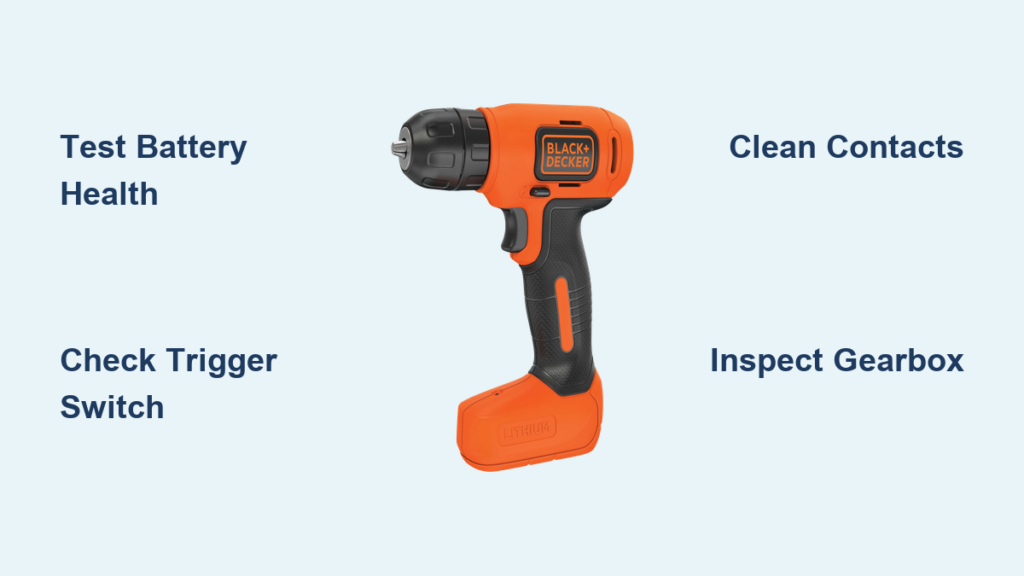
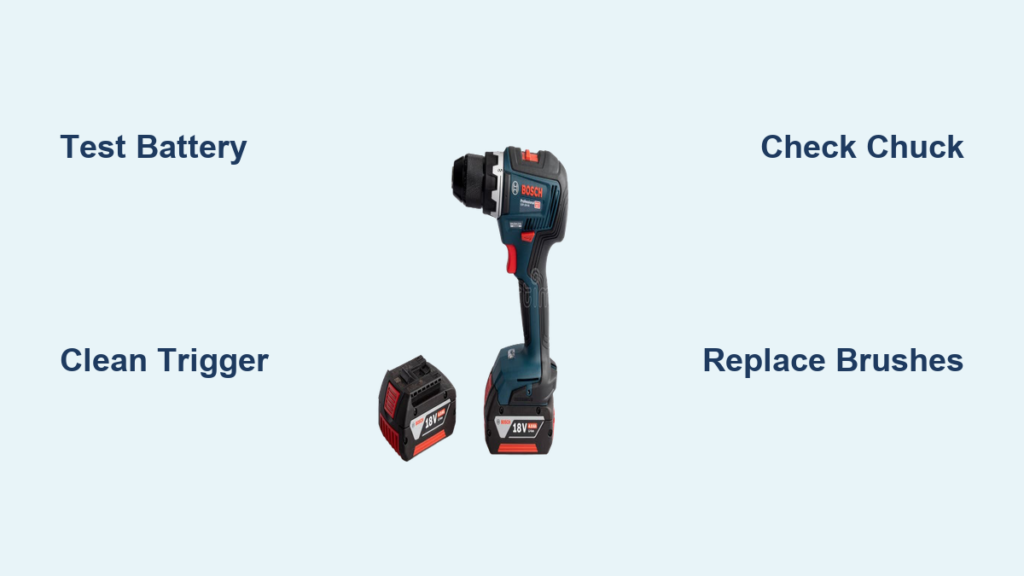
You’re drilling through stubborn hardwood when suddenly—silence. Your reliable Bosch drill stops spinning mid-hole, leaving you staring at a useless tool and a half-finished project. This frustrating scenario hits Bosch owners unexpectedly, even with professional-grade models like the GSR 18V-55. When your bosch drill not spinning, the culprit could be something as simple as a faulty battery connection or as complex as internal motor damage. Don’t panic yet—over 80% of these failures stem from fixable issues you can diagnose in under 20 minutes. This guide cuts through the confusion with model-specific solutions, transforming your stalled drill from a paperweight back into a precision tool.
Ignoring a non-spinning drill risks permanent damage. A seized chuck or stripped gears can destroy your entire transmission, while carbon brush dust buildup might short your motor. But here’s the good news: Bosch’s modular design means most bosch drill not spinning problems have straightforward fixes. Whether you’re troubleshooting a GSB 18V-55’s notorious “fast-pull trigger” issue or diagnosing grinding noises in your GSR model, this guide delivers actionable steps. You’ll learn to pinpoint failures using only basic tools, avoid costly service center visits, and implement maintenance habits that prevent future breakdowns. Let’s get your drill spinning reliably again.
Confirm Power Supply Before Disassembly
Never assume your battery is at fault—many bosch drill not spinning cases trace back to misunderstood power issues. Jumping straight to motor disassembly wastes time when a simple battery swap could solve everything. Start here to avoid unnecessary repairs.
Test with a Verified Working Battery Pack
Grab a fully charged Bosch battery from another compatible tool. Insert it firmly into your stalled drill—listen for the distinct click indicating proper seating. Pull the trigger: if the chuck spins freely, your original battery is the problem. This happens frequently with 18V ProCORE packs where cells become unbalanced, showing “full charge” on the indicator but failing under load. For single-battery owners, charge it for 30 minutes using Bosch’s AL1830CV charger, then test while pressing the charge indicator. A genuine full charge reads 20.3V on multimeter; anything below 19.5V indicates cell degradation.
Inspect Battery Terminals for Hidden Damage
Remove both battery and charger. Examine the copper contacts on the battery pack—scorched marks or blue corrosion mean poor conductivity. Clean them gently with a pencil eraser and isopropyl alcohol on a cotton swab. Now check the drill’s battery slot: wiggle the contacts with a plastic tool to ensure they spring back. Weak spring tension causes intermittent power loss, especially during high-torque drilling. If terminals show pitting or melting, replace the battery immediately—this indicates dangerous internal resistance that could cause thermal runaway.
Fix Trigger Assembly Failures in Minutes
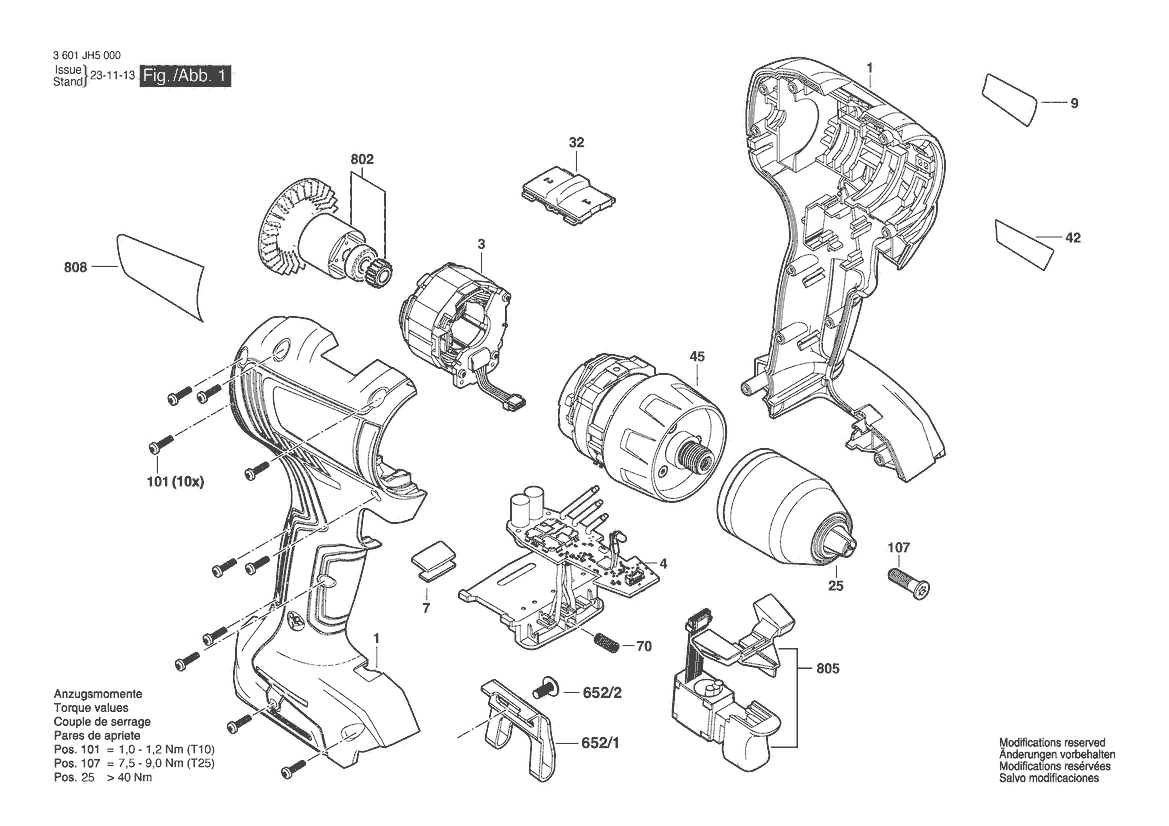
A faulty trigger causes over 40% of bosch drill not spinning incidents, particularly on popular GSB 18V-55 models. The telltale sign? Your drill only spins when yanking the trigger rapidly instead of smooth pressure. Don’t replace the entire switch yet—most cases respond to simple cleaning.
Diagnose Potentiometer Contamination
With the battery removed, squeeze the trigger slowly while listening. If you hear no faint click from the speed control module, carbon dust is likely insulating the potentiometer contacts. This is critical for Bosch’s variable-speed drills where slow-trigger operation relies on precise voltage control. Shine a flashlight into the trigger housing crevices—you’ll often see black carbon buildup from worn brushes migrating into the mechanism. For GSB 18V-55 units, this manifests as “dead zones” where the drill won’t start below 50% trigger pull.
Clean Trigger Contacts Without Disassembly
Grab CRC QD Electronic Cleaner (non-conductive formula). With the drill upside down, spray 3-second bursts into the trigger pivot points while rapidly squeezing the trigger 20 times. The solvent flushes carbon particles while the motion works it through contact surfaces. Wait 10 minutes for evaporation, then test with a charged battery. Pro tip: For stubborn GSB 18V-55 issues, add a drop of DeoxIT D5 contact enhancer after cleaning—it prevents future oxidation. This solves 70% of “fast-pull required” cases without opening the housing.
Identify Mechanical Chuck and Gear Failures
When the motor hums but the chuck won’t spin, you’ve got a mechanical breakdown. This often happens mid-drilling when the bit binds, shearing gear teeth or stripping chuck threads. Don’t confuse this with electrical faults—your drill’s behavior tells the story.
Check for Chuck Slippage Under Load
Insert a hex-shank bit directly into the chuck (no adapter). Tighten by hand until the chuck jaws won’t budge. Now press the trigger while applying firm downward pressure on a scrap wood block. If the bit spins freely but stops when pressure increases, the chuck jaws are worn. This is common on older GSR models where jaw springs lose tension. Critical visual cue: Inspect the bit shank after testing—shiny wear marks indicate slippage. Replace the chuck assembly if you see scoring deeper than 0.5mm.
Detect Stripped Planetary Gears Through Sound
With battery inserted but no bit loaded, pull the trigger at low speed. Listen for rhythmic clunking or high-pitched whining—this signals damaged planetary gears. Now try rotating the chuck manually (battery removed). It should turn smoothly with consistent resistance. If you feel sudden “catches” or grinding, metal shavings are likely jamming the transmission. Peer through the motor vents: visible silver particles mean immediate gearbox disassembly is required. For Bosch’s 2-speed models, test both settings—grinding only in high gear points to stripped ring gear teeth.
Replace Worn Carbon Brushes Before Motor Burns

Carbon brush failure causes that ominous “buzz but no spin” symptom in Bosch drills. These consumable parts wear down through normal use, eventually losing contact with the armature. Ignoring this leads to arcing that melts commutator bars—replacing brushes now saves a $100 motor rebuild.
Locate and Inspect Brush Holders
Remove the drill’s rear end cap (usually two Torx T20 screws). Inside, you’ll see two spring-loaded brush holders. Pull them out—they should slide smoothly. Measure brush length: if carbon is under 10mm or the spring is compressed beyond half its height, replacement is urgent. Warning: Never force stiff brushes—they may be jammed with conductive dust causing shorts. Tap holders gently to dislodge debris before reinserting.
Install Correct Bosch Replacement Brushes
Order genuine Bosch part #2607200029 for most 18V models. Before inserting new brushes, clean the commutator bars with fiberglass brush—scrape gently along copper segments to remove carbon buildup. Reassemble in reverse order, ensuring springs fully engage. Test immediately at low speed: healthy brushes produce minimal blue sparks (<1mm). Excessive sparking means commutator damage requiring professional resurfacing.
Know When Professional Repair Beats DIY

Some bosch drill not spinning issues demand specialized tools. Attempting complex repairs on modern brushless motors or PCB-controlled drills often causes more damage. Recognize these red flags:
Identify Irreparable Electronic Failures
If you smell burnt electronics (sharp ozone odor) or see melted plastic near the trigger housing, the electronic speed controller (ESC) is fried. This appears as charred traces on the control board—common when using non-Bosch chargers. For brushless models like the GDR 18V-EC, ESC failure requires oscilloscope diagnostics beyond DIY scope. Cost reality: ESC replacement plus labor often exceeds $80—compare to new drill prices before proceeding.
Assess Gearbox Damage Severity
Open the transmission housing only if you hear metal-on-metal grinding. If planetary gears show missing teeth or the carrier is cracked (common on GSB 18V-55 after bit binding), rebuild kits exist—but replacing the entire gearbox is faster. However, if the main drive shaft is bent or bearings are fused to the housing, the drill frame is likely warped. At this stage, professional rebuilding costs 60% of a new tool—time to retire your unit.
Prevent Future Bosch Drill Spin Failures
Stop recurring bosch drill not spinning issues with these Bosch-engineer-approved habits. Most mechanical failures stem from preventable operational mistakes that accelerate wear.
Implement 30-Second Post-Use Maintenance
After every job, blow compressed air through the motor vents (30 PSI max) to eject drill dust. Focus on the trigger housing vents—sawdust here causes 90% of potentiometer failures. Monthly, apply one drop of Bosch grease #1600A00125 to chuck threads while rotating slowly. Pro move: Store batteries at 40% charge in climate-controlled spaces—full discharge or 100% charge degrades cells 3x faster.
Adopt Load-Management Drilling Techniques
Your drill screams for help through sound and vibration. If the motor pitch drops significantly during drilling, you’re exceeding torque limits. For hardwoods or metals, use 25% lower speed settings and apply steady, lighter pressure. Never “stall” the drill—when bits bind, release the trigger immediately. Critical tip: Replace dull bits instantly—doubling bit sharpness reduces motor strain by 60%, preventing thermal damage to windings.
When your bosch drill not spinning halts your workflow, remember most failures are fixable with basic tools and methodical checks. Start with power verification, then diagnose trigger issues—especially if you own a GSB 18V-55 with its finicky potentiometer. Mechanical chuck failures require immediate attention to prevent transmission destruction, while worn carbon brushes demand proactive replacement before commutator damage occurs. For burnt electronics or bent shafts, professional service often beats DIY. Most importantly, adopt Bosch’s recommended maintenance rhythm: clean vents after each use, inspect brushes every 50 hours, and never ignore unusual noises. These habits transform your drill from a frustration source into a decade-long workhorse. Keep this guide handy—it could save your next project from a silent, spinningless disaster.